You’re Not Getting Old
You’re Not Getting Old
Why chronic sitting is building a body that feels like it is
There is a version of you that moved without thinking about it. You stood up and just stood up. You turned quickly without planning the turn. You caught yourself when you stumbled because your body responded before your brain finished the thought.
That version of you is not gone. But if you have spent the last several years at a desk, it has been quietly reassigned.
Here is what nobody tells you about chronic sitting: your body is not breaking down. It is adapting. Every system in your body is designed to get better at whatever you ask it to do most. Spend enough hours in a chair, and your body optimizes for the job like any good worker would.
The problem is that the job is sitting.
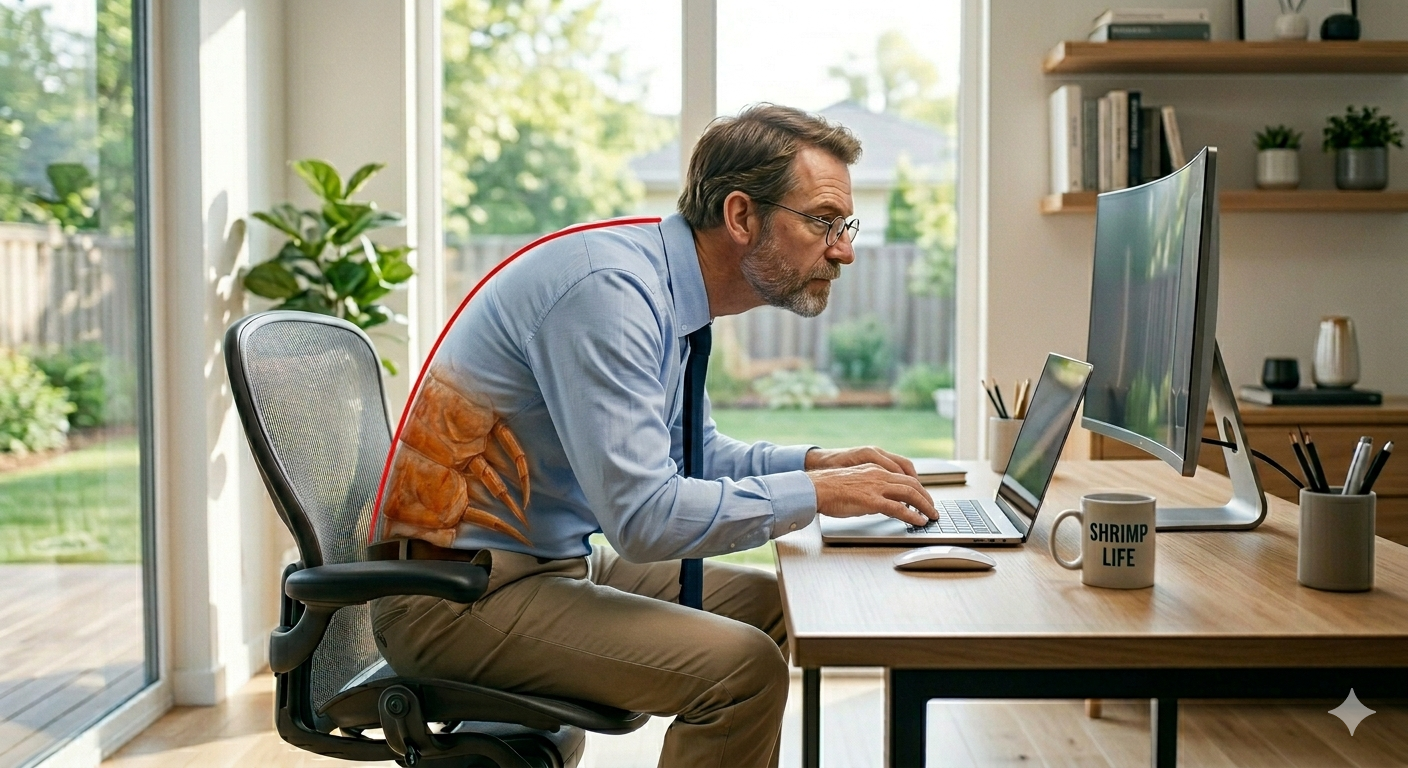
Your hip flexors shorten because they no longer need to extend. Your glutes stop firing on cue because the chair does their job for them. Your spine learns a new normal, one that involves a slow forward curl that starts at the low back and works its way up through the shoulders and neck. Over time the head drifts forward, the chest closes in, the whole upper body begins rounding toward the screen. You recognize it in other people immediately. In yourself, it sneaks up. One day you catch your reflection in a window or a storefront and something looks different. The silhouette isn’t quite upright anymore. From the side, it’s starting to look less like a person standing tall and more like something you’d find on a seafood menu.
That’s the shrimp body. Your body built it for you as a favor. It just didn’t ask permission first.
At the base of your skull, four small muscles spend their entire shift making micro-adjustments to keep your head level and your gaze forward. They are precise, they are tireless, and they are very bad at being ignored. Chronic sitting doesn’t fire them. It just buries them. And when The Supervisor finally speaks up, it usually isn’t subtle.
This is where most people make a mistake. They feel the stiffness, the sluggishness, the general sense that something has slowed down, and they file it under aging. It feels like aging. It arrives around the age when people expect aging. But the culprit isn’t your birthday. It’s your chair, your commute, your couch, and the ten thousand hours you have logged in all three.
I spent fifteen years as a massage therapist, most of that time on my feet, moving bodies, working with my hands, staying physical by default. Before that, a decade in food retail and three years in a warehouse. My body knew how to work because it had to. Then I spent two years at a desk.
Two years.
That’s all it took to feel what my clients had been describing for years. The hips that felt locked in the morning. The back that complained on the stairs. The general sensation of moving like someone who had forgotten how to move quickly. My body hadn’t aged ten years in two. It had just gotten very, very good at sitting.
Here is what chronic sitting actually takes from you, and this is the part worth paying attention to.
What disappears quietly is power. Not strength, but power. You can still be strong, but power is different. Power is what gives you the ability to react. To catch yourself when the floor is wet or the curb is higher than you expected. The fast response that used to be automatic before your body decided it wasn’t part of the job description anymore.
Your nervous system is a use-it-or-lose-it system. The movement patterns you practice are the ones that stay sharp. The ones you stop practicing get reassigned, deprioritized, moved to the back of the filing cabinet. Chronic sitting doesn’t just change your posture. It quietly trains your entire system to move slowly, react slowly, and generate force slowly.
That is what makes you feel old. Not time. Pattern.
The good news — and there is real good news here — is that you do not need to become an athlete to reverse it. You need to remind your body that it has other gears. A short walk that isn’t a stroll. Standing up from your chair without using your hands. Taking the stairs like you mean it. None of these are dramatic. But they are information. Every time you ask your body to do something other than sit, you are sending a signal that the old job description still applies. That speed still matters. That power still has a place. The body that adapted to chronic sitting can adapt back. Adapting is exactly what bodies do when you give them a reason.
You are not getting old. You just got very good at sitting.
It’s time to get good at something else.
Companion Piece