
Neighborhood 4 — Lower Back
The Accountant
Worker 13 — Quadratus Lumborum (QL)
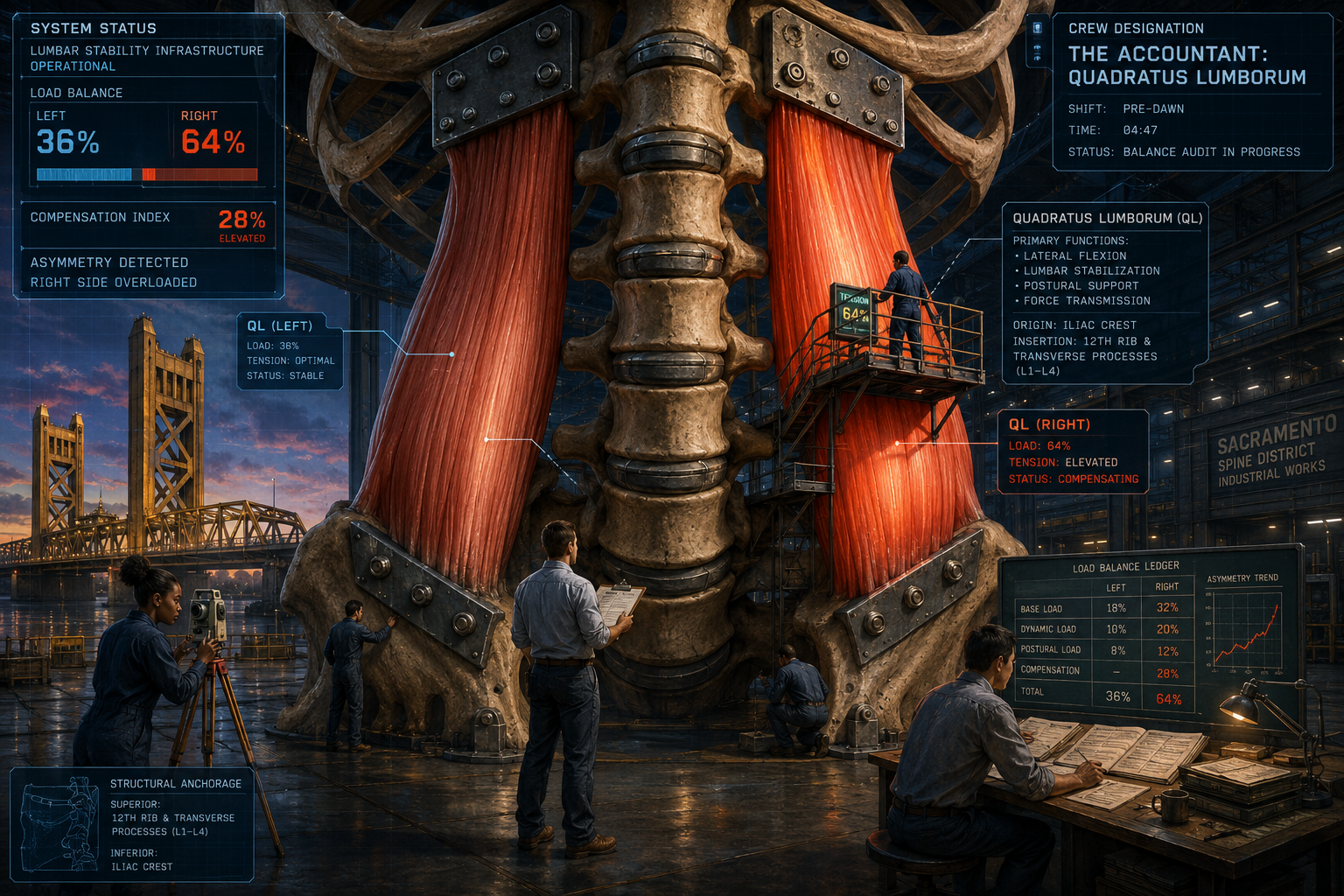
The quadratus lumborum doesn’t get mentioned in casual conversation about back pain. People talk about slipped discs and tight hamstrings and tight hip flexors and poor posture, but the QL sits quietly in the background of almost every low back story, keeping the books no one else wants to look at. It runs from the top of the pelvis up to the twelfth rib and the lumbar vertebrae, connecting the hip to the spine in a short, dense column of muscle that works in three directions at once. It hikes the hip, stabilizes the lumbar spine against lateral collapse, and assists with extension. It also, when overloaded, produces some of the most disabling low back and referred hip pain in the body.
The accounting metaphor fits because the QL tracks everything. Every asymmetry in the pelvis, every leg length discrepancy real or functional, every hour spent sitting crooked or carrying a bag on one shoulder, every night on a mattress that lets the pelvis sink — the QL is recording all of it. It doesn’t complain right away. It adapts. It shortens on one side to hold up the pelvis, or it tightens bilaterally to keep the lumbar spine from collapsing under a load it wasn’t adequately braced for. The complaints come later, when the adaptation has reached its limit.
The pain referral pattern of the QL is one of the reasons it gets missed so frequently. A tight or dysfunctional QL doesn’t always produce pain exactly where it lives. It refers pain to the sacroiliac joint, the outer hip, the groin, the side of the thigh, even the front of the thigh. People come in convinced they have SI joint problems, or hip problems, or even kidney issues. The QL was doing the referring the whole time.
The dominant pattern most practitioners find is a unilateral QL that’s been shortened and overactivated on one side, usually the side of the higher hip or the side that compensates for a weak gluteus medius on the opposite side. The body is solving for stability any way it can find, and the QL is one of the fastest available solutions. Fast solutions that run too long become chronic problems.
Releasing the QL through direct soft tissue work — carefully applied because the muscle is deep and surrounded by important structures — provides immediate relief that most people recognize as significant the first time they experience it. The referred pattern begins to quiet. The hip feels less locked. The low back stops guarding at the same pitch. But release alone doesn’t keep the books balanced. The gluteus medius needs to take its share of the lateral stability load. The core needs to provide the bracing that keeps the QL from being the last line of defense. The Accountant needs colleagues who show up.
The QL is a small muscle doing enormous work. Respecting that work, addressing the compensation patterns that sent it into overdrive, and rebuilding the surrounding infrastructure is the difference between feeling better for a week and actually changing how the lower back runs. The books don’t balance themselves. But once someone finally looks at them, the path forward is usually clearer than the pain suggested it would be.