Neighborhood 5 — Hip District
The Foreman
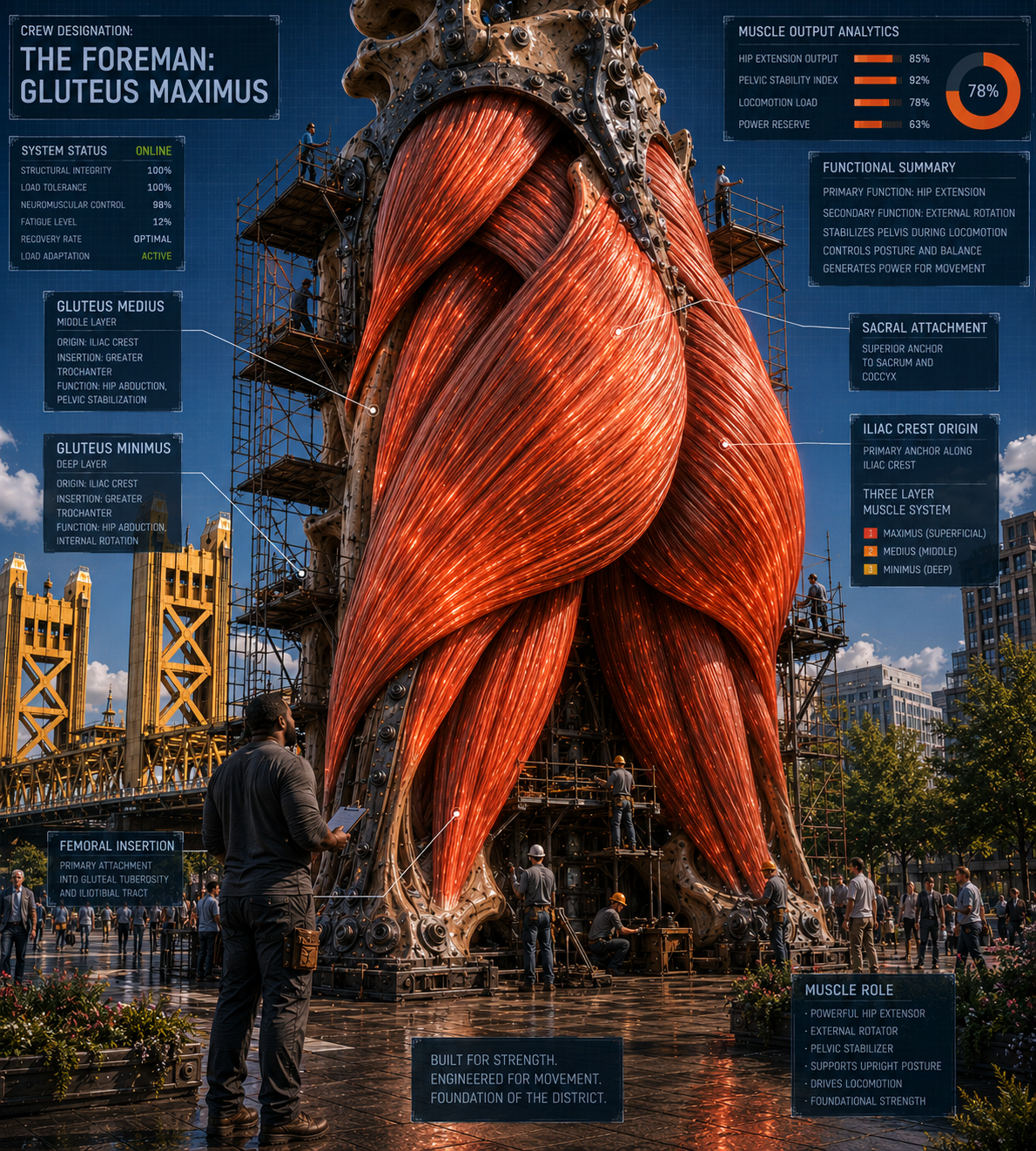
Worker 15 — Gluteus Maximus
The gluteus maximus is the largest muscle in the human body and, by a significant margin, the most underperforming one in modern life. It’s built for power — hip extension, external rotation, pushing the body forward and upward against gravity — but the average person who sits for most of the day has taught their nervous system to bypass it almost entirely. The hip extends when it needs to, but the erector spinae and hamstrings pick up the load while the glute max sits quiet, not forgotten exactly, just not trusted to show up anymore. This is called gluteal amnesia, and the problems it creates travel in every direction.
The foreman metaphor is apt because the glute max doesn’t just do its own job. It manages the whole district. It controls pelvic position. It protects the sacroiliac joint by providing the compression force that keeps it stable. It governs how the femur moves in the hip socket, which determines how the knee and ankle function downstream. When the foreman goes off the job, every other worker in the hip district has to compensate, and they all feel it eventually.
The most visible consequence of glute max underperformance is what happens to the lower back. The erector spinae are not designed to be primary hip extensors, but when the glute max won’t engage, they become exactly that. The lordotic curve in the lumbar spine increases as the erectors contract hard to compensate for missing power at the hip. The QL braces laterally for stability. The hamstrings shorten trying to assist with extension at a range they’re not built for. The whole lower back neighborhood works twice as hard because the foreman on the floor below isn’t showing up.
Rebuilding glute max function after years of underuse requires more than just adding squats and lunges to a routine. The problem isn’t strength in isolation. It’s recruitment — getting the nervous system to fire the glute max first, not as an afterthought. Hip thrusts, glute bridges with intentional glute activation cues, single-leg work that demands pelvic stability — these are the tools that retrain the motor pattern rather than just loading the muscle. The difference between someone who can squat 200 pounds and still not use their glutes properly and someone whose glutes fire every time they take a step is not strength. It’s recruitment pattern.
Soft tissue work plays a role here in clearing the compensating muscles that have been working overtime — the hamstrings, the erectors, the hip flexors that have adaptively shortened to fill the postural vacuum the glute max left. A hip that’s structurally capable of full extension but never achieves it because the flexors are too short is a hip that can’t give the glute max the range it needs to do its job. Both ends of the problem need attention.
The foreman’s return to the job changes how the whole district runs. Knees that were tracking poorly start to align. Lower back pain that didn’t respond to lumbar treatment starts to shift when the glute max is actually producing force at the hip. The SI joint stabilizes. The body finds the foundation it was always supposed to have. It was there the whole time. It just needed someone to call the foreman back in.