Neighborhood 6 — Leg & Foot
The Traffic Controllers
Worker 19 — Quadriceps & Hamstrings
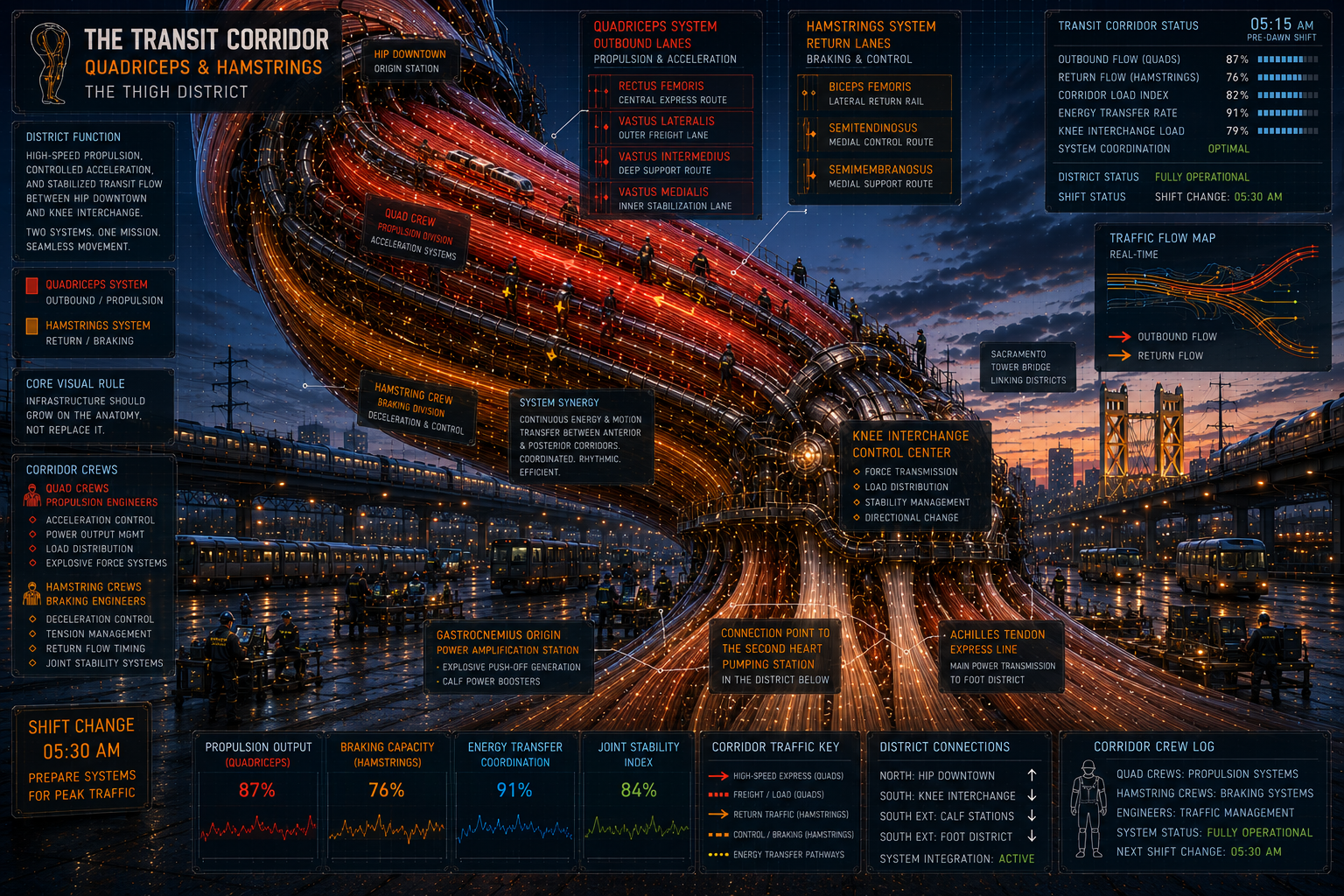
The quadriceps and hamstrings are the major force producers of the thigh, operating on opposite sides of the knee joint in a relationship that controls nearly every significant lower body movement. Four muscles on the front — rectus femoris, vastus lateralis, vastus medialis, vastus intermedius — extend the knee and provide the power for walking, running, climbing, and absorbing impact from above. Three muscles on the back — biceps femoris, semimembranosus, semitendinosus — flex the knee and extend the hip, working in coordination with the glute max to drive the body forward. These are the traffic controllers of the leg district because they regulate force in both directions and their balance determines how the knee and hip load.
The ratio between quadriceps and hamstring strength is one of the most studied relationships in sports medicine, and for good reason. When the quads are significantly stronger than the hamstrings — the dominant pattern in most training programs that emphasize squatting and pressing without equivalent posterior chain work — the knee is at higher risk of anterior ligament stress and the hamstrings are at higher risk of strain. The hamstrings work as both knee flexors and hip extensors. When the glutes aren’t doing their share of the hip extension load, the hamstrings compensate upward, which means they’re also chronically shortened at the top and under strain at the bottom.
Most hamstring tightness that people experience — the feeling of short, pulling hamstrings when bending forward — is not actually tightness in the mechanical sense. The muscles are often at a normal or even excessive length. What’s happening is neural tension. The sciatic nerve runs through the hamstring compartment, and a nervous system that is guarding the low back or the hip will increase the sensitivity of that nerve, producing the sensation of tightness that doesn’t respond to stretching because it isn’t about the muscle’s length. Treating neural hamstring tightness with aggressive stretching can irritate the sciatic nerve further and make things worse.
The quadriceps present their own common pattern. The vastus medialis — the teardrop-shaped muscle on the inside of the knee — frequently underperforms relative to the vastus lateralis, creating a lateral pull on the patella that produces the anterior knee pain known as patellofemoral syndrome. The patella doesn’t track wrong because of a knee problem. It tracks wrong because of a quad imbalance, often made worse by weak hip external rotators and glutes that aren’t keeping the femur from internally rotating under load. The traffic is moving wrong because the controllers upstream aren’t coordinating.
Soft tissue work on the quadriceps and hamstrings provides real relief for chronic tension patterns and for the adhesion that builds in muscles that have been working in compensation. But the lasting change comes from rebalancing the loads — strengthening the posterior chain to match the anterior dominance of most training programs, addressing the hip mechanics that are producing the upstream problems, and reestablishing proper neuromuscular coordination between the quads and hamstrings so the knee can handle what life asks it to handle.