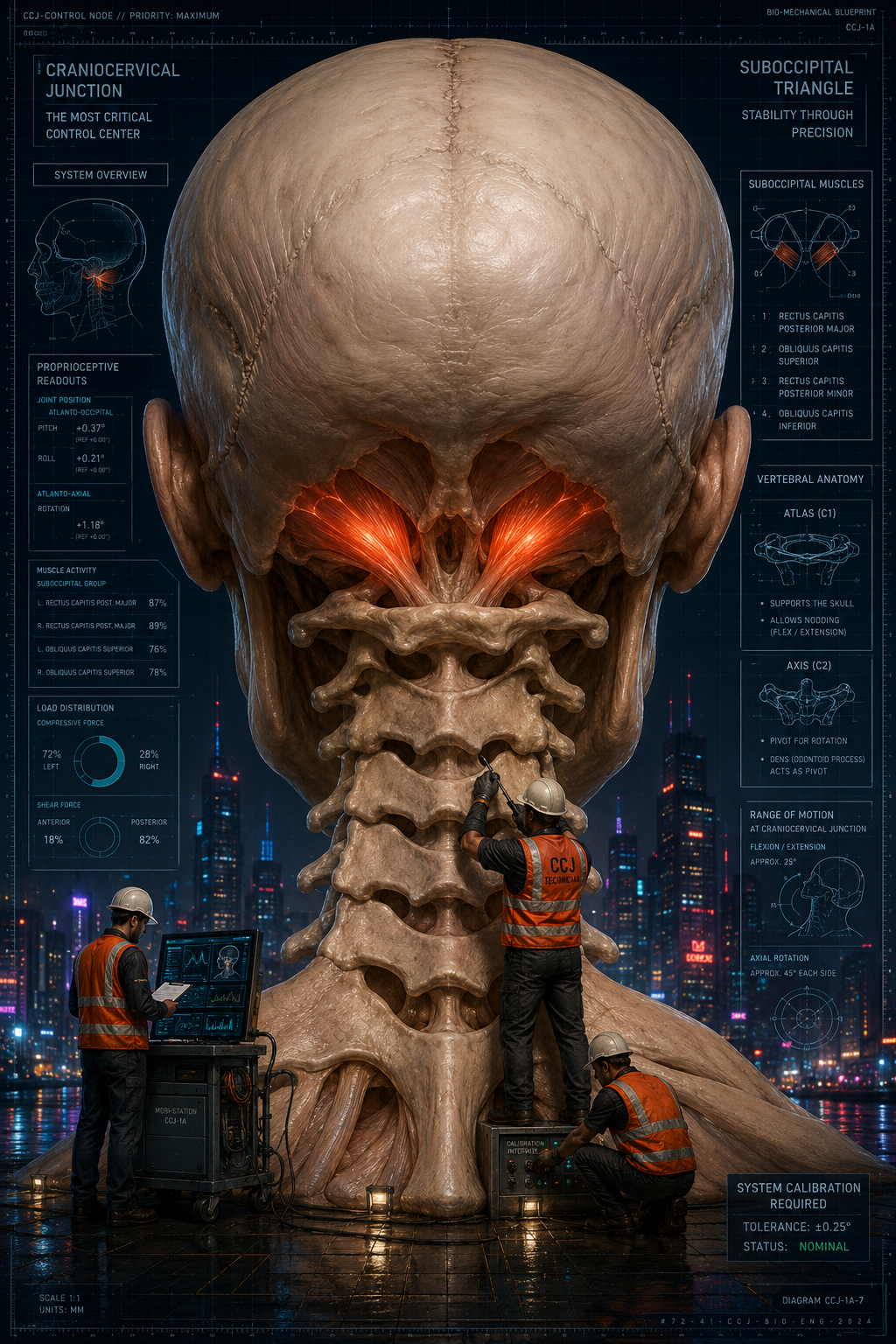
Four muscles. Barely the size of your thumb each. Sitting at the most important intersection in the entire district — the joint between the skull and the top two vertebrae. This is where the yes nod lives. Where the no shake lives. The Supervisor doesn’t generate big force. It handles precision work: micro-adjustments, millimeter-level positioning, the kind of fine motor control you never think about until it stops happening.
What makes the Supervisor different from every other worker in Body City is what it’s carrying besides tension. These four muscles contain more proprioceptive nerve endings per gram of tissue than almost anywhere else in the human body. Proprioception is the body’s internal GPS — the system that tells your brain where your parts are in space without you having to look. The Supervisor doesn’t just move the head. It tells the rest of the body where the head is. When the Supervisor’s signal gets noisy, the whole system starts navigating blind.
Screen time is what breaks it. Not dramatic injury. Not a single bad movement. Just hours in one position, day after day, until the precision circuitry starts to seize. The muscles shorten. The joint loses its range. The GPS signal gets unreliable. The brain starts making compensation decisions based on bad data, and the upper body adjusts accordingly — usually in ways that create problems somewhere else before anyone traces it back to four small muscles at the base of the skull.
The pain pattern is disorienting because it doesn’t feel like a muscle problem. It feels deep, hard to locate, like it’s coming from inside the skull rather than on the surface. Tension headaches that wrap from the base of the skull over the top toward the eye. Dizziness that has nothing to do with the inner ear. Eye strain that isn’t about your prescription. If you’ve ever had a headache that felt like it was behind your eyes and inside your head at the same time, the Supervisor is worth knowing about.
The fix isn’t aggressive. Slow, deliberate head movement — not stretching, actual movement through range. Chin tucks that restore the curve the joint is supposed to have. And the simplest intervention in this entire district: looking away from the screen for twenty seconds every twenty minutes. That’s enough to interrupt the static hold pattern and remind the Supervisor it’s allowed to move.