Neighborhood 3 — Upper Back
The Scapular Transit Crew
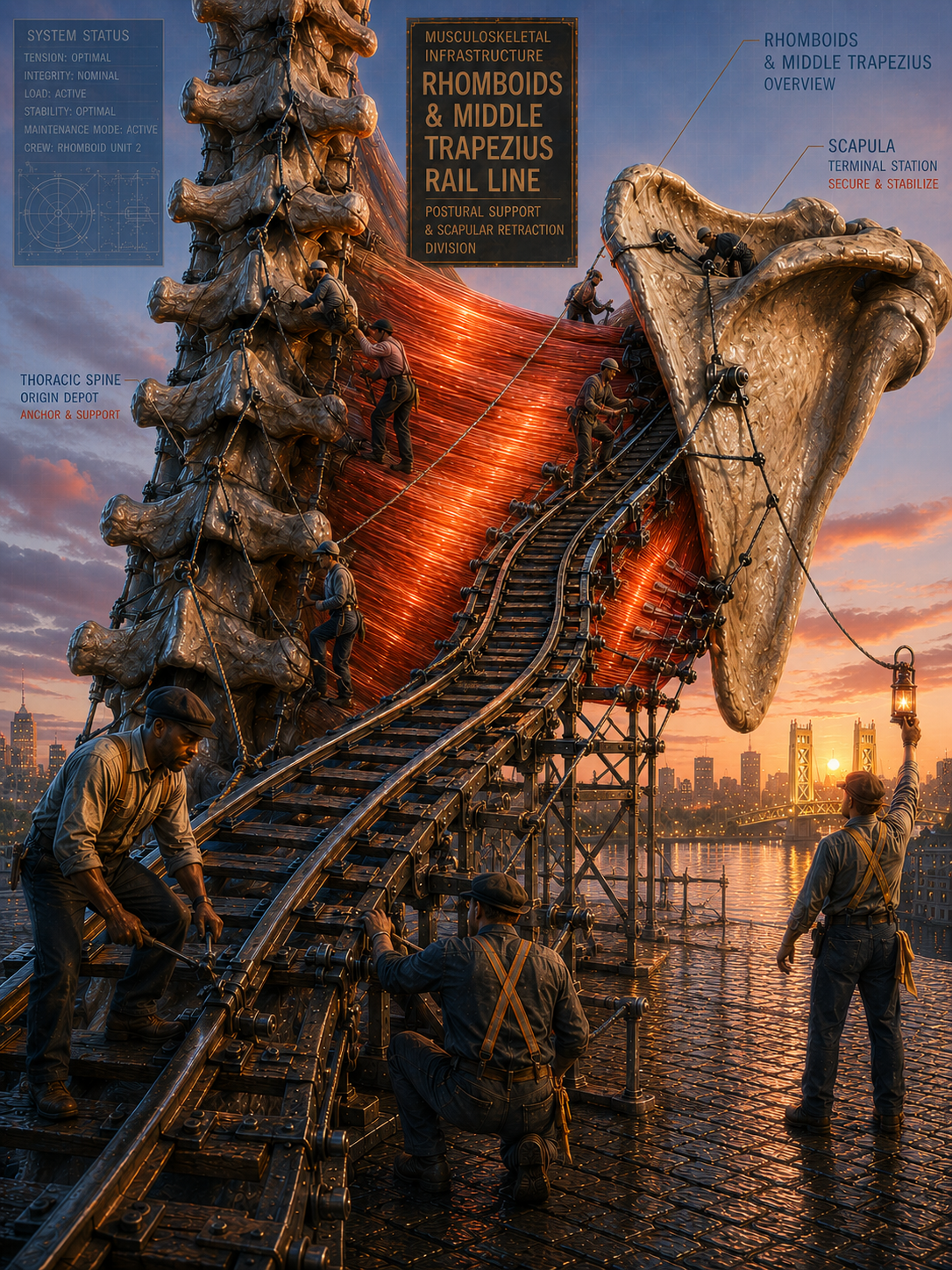
Worker 10 — Rhomboids & Middle Trapezius
The mid-back ache between the shoulder blades is one of the most common things people carry around without doing much about. It’s not sharp enough to stop them, not dramatic enough to feel urgent, just a persistent dull tension that shows up after sitting too long or working at a screen and never fully leaves. Most people have pressed on it themselves, felt the tenderness, and concluded that whatever is in there is tight and needs to be loosened up. That conclusion is understandable. It’s also usually backwards.
The rhomboids and middle trapezius are the muscles living in that territory. They run between the spine and the shoulder blade, and their job is to retract the blade — to pull it back toward the spine and hold it there against the forward pull of everything on the other side. In a body that spends most of its time reaching forward, these muscles are constantly being stretched. Not tight. Stretched. The tenderness people feel when they press on them isn’t the tenderness of a muscle that’s been overworked into shortness. It’s the tenderness of a muscle that’s been pulled too long in the wrong direction and is running out of the strength to hold on.
This is the part that gets missed. The instinct when something hurts is to stretch it. The rhomboids feel tense, so people stretch across the body, pulling the shoulder blade forward, getting temporary relief that makes the underlying problem slightly worse with every repetition. What those muscles actually need, in most cases, is to be strengthened. They need load, not length. They need to be asked to do the thing they’ve been losing the capacity to do, which is hold the shoulder blade back where it belongs against the constant pull of a lifestyle that keeps reaching forward.
“The ache is fatigue, not tightness. The distinction matters because the treatment is different.”
The forward pull usually comes from the chest. A shortened pectoralis minor tilts the shoulder blade forward at the tip. A tight pectoralis major pulls the whole shoulder into internal rotation. The rhomboids and middle trapezius are on the other end of that rope, and they’ve been losing ground slowly for a long time. By the time someone notices the mid-back ache, the transit line between the spine and the shoulder blade has been under sustained tension long enough that the crew running it is genuinely fatigued. The ache is fatigue, not tightness. The distinction matters because the treatment is different.
When the rhomboids are chronically lengthened and underperforming, the effects travel in both directions. The shoulder blade drifts forward and loses its stable position, which means the rotator cuff and deltoid are working from a compromised base. The neck compensates for the instability above it, which is one reason people with chronic mid-back tension between the shoulder blades also tend to carry persistent neck tightness that doesn’t make obvious sense on its own. The scapular transit crew connects the shoulder to the spine, and when that connection is weak, both ends of the line feel it.
Soft tissue work in this area can provide real relief by addressing the chronic tension that builds in muscles holding a lengthened position under load for extended periods. But it works better when it’s paired with strengthening rather than used as a substitute for it. Rows, face pulls, band pull-aparts — movements that ask the shoulder blades to retract against resistance — rebuild the capacity that prolonged forward posture has been quietly draining. Opening the chest at the same time, working directly on the pectoralis minor and major to take some of the forward pull off the system, gives the rhomboids and middle trap a fighting chance at holding the position they regain.
The transit crew isn’t the problem. It’s been managing a route that got harder without anyone adjusting the schedule. Give those muscles something to push back against, take some of the load off the front of the system, and the mid-back ache that felt like tightness usually turns out to be something that responds to being worked rather than stretched.