Neighborhood 4 — Lower Back
The Engineers
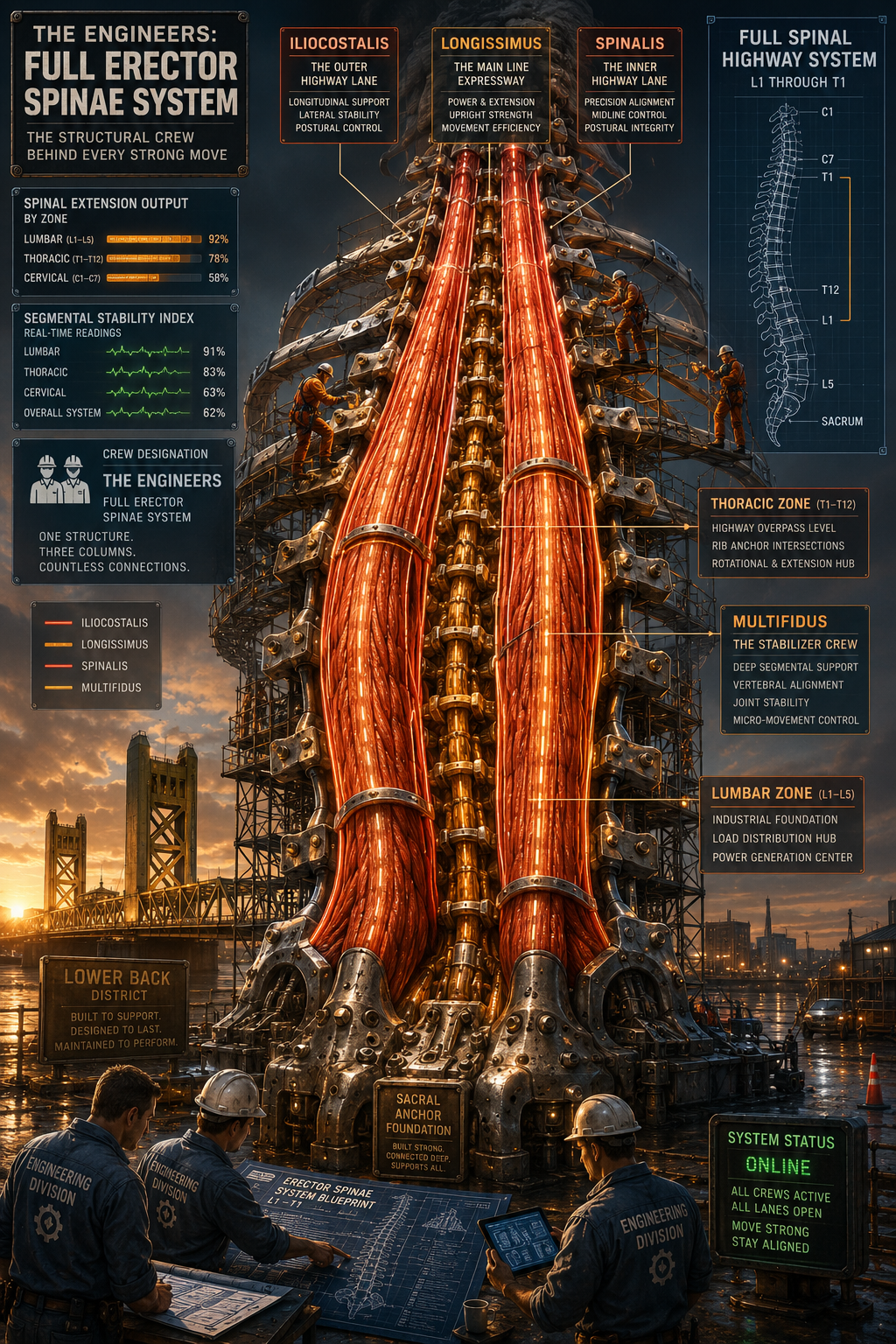
Worker 12 — Erector Spinae — Full Spinal Highway System
Most people think of their back as one thing. It aches in one place, so the problem must be in one place. The reality is that the back is a long, complex system running the full length of the spine, and the erector spinae are the crew that built and still maintains the entire highway. Three columns of muscle — iliocostalis, longissimus, spinalis — running from the pelvis all the way to the base of the skull. They don’t work for one segment. They work for the whole route.
The engineers hold the spine upright against gravity every moment you’re not lying down. They extend the back, rotate the trunk, and create the structural support that lets everything above do what it needs to do without the whole system collapsing forward. When you stand up from a chair, when you carry something, when you reach up or twist to look behind you, the erector spinae are the crew managing the load on the vertical structure that makes all of it possible.
The problem that sends people in for help is almost always low back pain. But low back pain that lives in the erector spinae is different from the kind that lives in the quadratus lumborum, different from the kind coming from the psoas, and treating them interchangeably is one of the most common reasons low back pain keeps coming back. The erectors are the longitudinal system. The QL and psoas are the transverse stabilizers. Getting the distinction right changes everything about what you do next.
When the erector spinae are chronically overloaded, they tighten to brace against instability. If the deep stabilizers — the multifidus, the deep core — aren’t doing their segmental job, the erectors recruit hard to take up the slack. They’re designed for long-haul work, not for emergency constant bracing. Asking them to fill both roles produces the low-grade spinal stiffness and fatigue that most people associate with getting older, but that is usually a training and load management problem, not an age problem.
Soft tissue work on the erectors provides real and meaningful relief when the muscles are carrying chronic brace tension. But it’s a reset, not a fix. The fix is retraining the system underneath — rebuilding the deep segmental stability that takes the emergency response off the erectors and lets them return to their actual job, which is extending and rotating the spine, not holding it together through sheer chronic effort.
The Engineers manage the longest highway in the body. Every neighborhood connects to this route. When the highway is maintained — when the erectors can work at appropriate tension across their full range, supported by a functional deep core — the whole city runs better. When the maintenance falls behind, every neighborhood on the route starts to feel it eventually.