Hip
Neighborhood
The Crossroads · Power Generation · Rotation Control
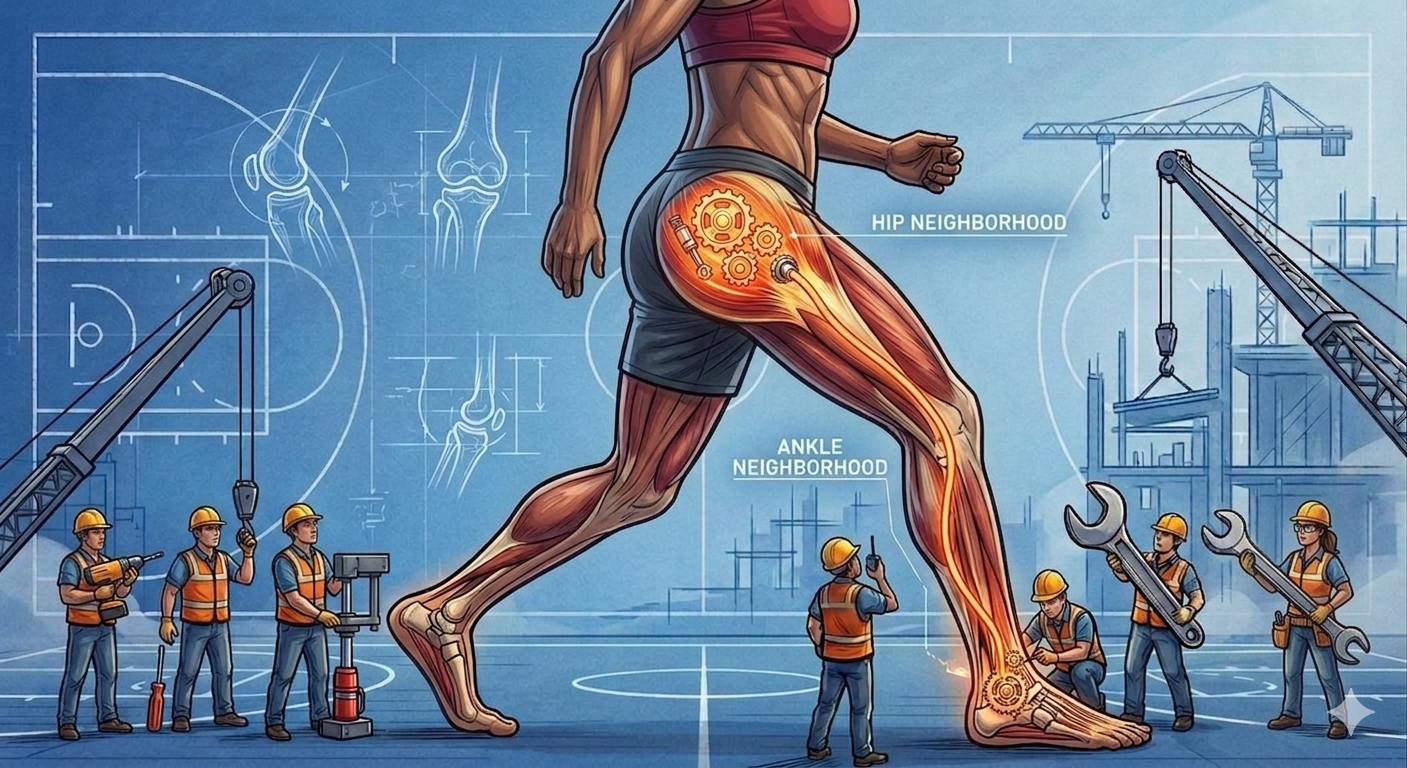
The Hip is the city’s crossroads. Everything passes through here.
Power generated in the legs travels up through the hip on its way to the trunk, and forces coming down pass through on the way to the ground. When you deal with chronic hip flexor tightness or poor glute activation, the whole city reorganizes around the deficit in ways it was never designed to sustain.
What This Neighborhood Does
Three operations define this district. Power generation — the hip extensors, primarily the Foreman, produce more raw force than any muscle group in the body. This is where athletic performance comes from, where walking economy lives, where the engine is. Rotation control — the ability to manage internal and external rotation of the femur within the hip socket determines how the knee, the ankle, and the lower back all load. And crossroads management — because the hip joint is the junction between the lower extremity and the axial skeleton, what happens here travels in both directions every time the body moves.
The Foreman is the most important worker in the city. When the Foreman stops showing up, everyone else starts covering. And they all eventually break down doing it.
The Workers
The largest muscle in the human body carries that distinction for a reason. The gluteus maximus extends the hip, controls external rotation, stabilizes the pelvis on the femur during single-leg loading, and decelerates hip flexion in movements like running and stair descent. It is the primary engine of locomotion and the cornerstone of every movement pattern that involves moving the body through space. When the Foreman is doing his job, the lower back is quiet, the knee tracks correctly, and the SI joint is stable. When the Foreman checks out — which sitting culture has been engineering for decades — the body doesn’t stop moving. It just starts compensating. The lower back tightens. The TFL takes over. The hamstrings get strained doing hip extension work they were never meant to handle alone.
No other muscle in the body crosses as many structural borders as the psoas. It attaches to every lumbar vertebra, crosses the pelvic brim, and connects to the lesser trochanter of the femur — a path that makes it simultaneously a hip flexor, a lumbar stabilizer, and a structural bridge between two neighborhoods that would otherwise have no direct connection. The Bridge Builder is the reason you cannot solve lower back pain without addressing the hip, and why hip flexor tightness so reliably produces lower back symptoms. When it shortens — as it does in everyone who sits for extended periods — it anteriorly tilts the pelvis, compresses the lumbar segments, and changes every movement pattern that follows.
The TFL runs from the outer edge of the pelvis down to the IT band, and from there all the way to the lateral knee. Its jobs are hip flexion, abduction, and internal rotation, plus lateral stabilization of the knee through its connection to the IT band. The Security Guard holds the outer perimeter. The problem is that when the Foreman stops working, the TFL gets promoted to a job it was never meant to hold. It starts doing hip extension work, it overtightens the IT band, and it starts pulling on the outer knee in ways that produce the syndrome that bears the IT band’s name. Most IT band problems are Foreman problems in disguise.
Six muscles deep in the posterior hip — piriformis, obturator internus and externus, gemellus superior and inferior, quadratus femoris — collectively manage external rotation of the femur and keep the femoral head centered in the acetabulum during movement. Like the Rotator Utility Crew in the shoulder, these workers are invisible until they aren’t. They don’t generate headline-grabbing force. They maintain joint integrity and rotational control at the hip every time the leg moves. When they tighten — and they will when the Foreman isn’t loading them correctly — the piriformis in particular starts referring pain down the leg in patterns that mimic sciatica closely enough to generate a lot of unnecessary imaging.
Deep Dive The Deep Six — The Utility Crew of the Hip District →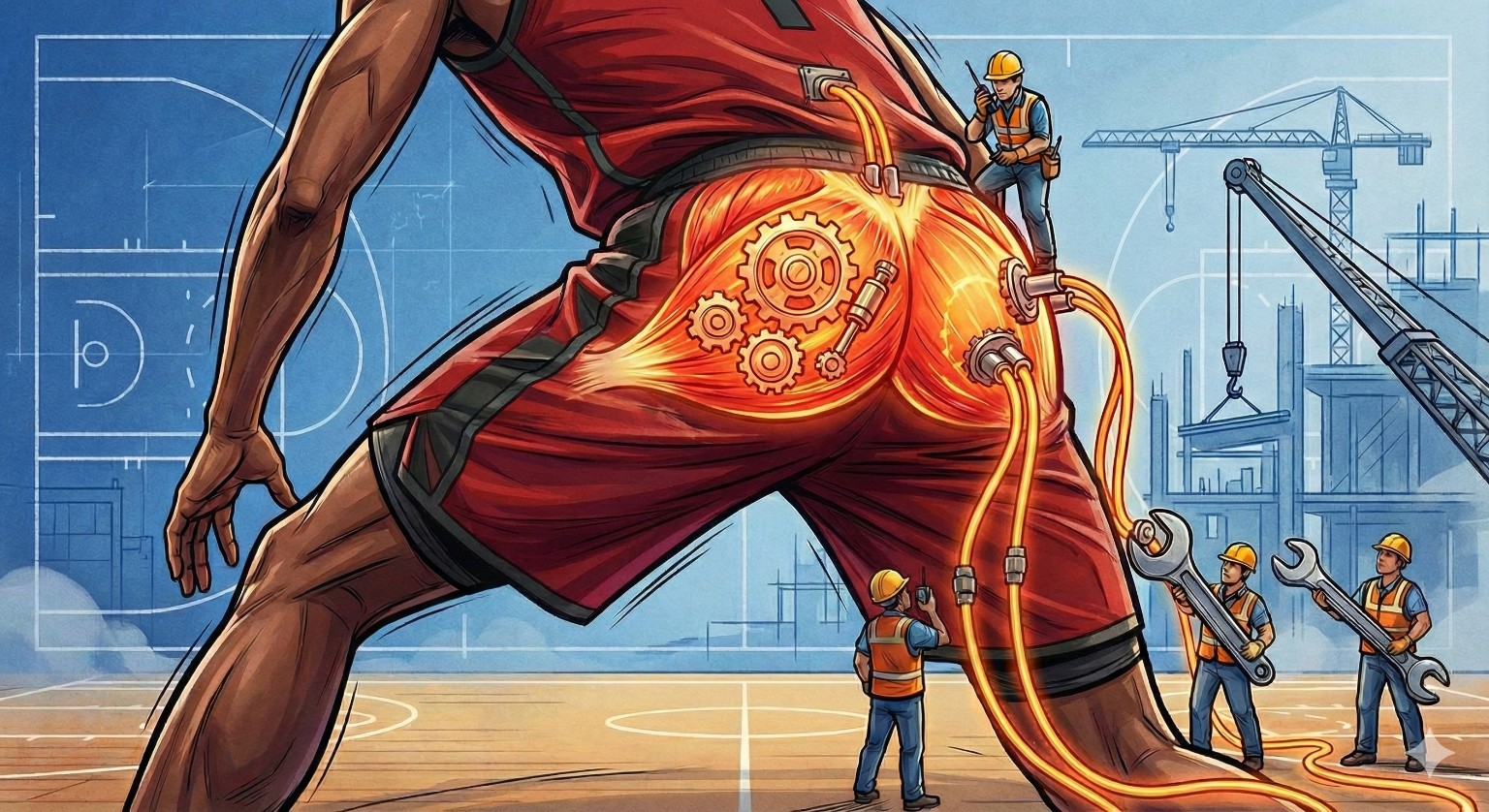
Common Problems
Glute amnesia — the informal term for a gluteus maximus that has been sitting so long it has functionally forgotten how to fire correctly — is the root cause of more problems than any other single dysfunction in the city. IT band syndrome, patellofemoral pain, lower back strain, SI joint dysfunction, hip flexor tightness, hamstring injuries: a significant portion of all of these trace directly back to an underactivated Foreman and the compensations that fill his absence.
Anterior hip pain, particularly during deep hip flexion, often involves the deep hip flexors and the joint capsule being compressed in a joint that lacks posterior support. The hip joint itself can handle enormous loads when the supporting crew is doing its job. When it isn’t, the joint absorbs what the muscles should have managed.
What Happens When Workers Go On Strike
The Hip neighborhood’s failure doesn’t usually announce itself with hip pain. It announces itself everywhere else. The lower back hurts because the psoas is pulling on it and the glutes aren’t stabilizing the pelvis. The IT band aches because the TFL is doing the Foreman’s job. The knee hurts because hip rotation control has broken down and the femur is collapsing inward. The SI joint locks up because nothing is keeping the pelvis stable on the sacrum. The whole city has a problem, but the origin address is Hip.
Self-Repair
Glute activation is the starting point for almost everything that goes wrong in this neighborhood and the neighborhoods around it. Bridges, single-leg work, and movements that require the glute max to extend against resistance rebuild the Foreman’s willingness to show up. Psoas stretching — specifically the kind that lengthens the muscle without substituting lumbar extension — addresses the Bridge Builder’s tendency to shorten. Deep hip rotator mobility work through controlled rotation in various hip positions keeps the Utility Crew from locking down. None of it is complicated. All of it requires consistency.
Connection to Neighboring Districts
The Hip neighborhood talks to everyone. Lower Back directly above it shares the psoas and absorbs every compensation the Hip generates. Leg & Foot below it depends on what the hip does with rotation and pelvic position to determine how the knee tracks, how the ankle loads, and where foot strike happens. When the Hip is organized, both of those neighborhoods function. When the Hip is not, both of them compensate. There is no more central address in the city.
Neighboring DistrictLower Back Neighborhood → Neighboring DistrictLeg & Foot Neighborhood → Return toBody City Overview →