Neighborhood 2 — Shoulder & Arm
The Wranglers
Worker 9 — Serratus Anterior
A lot of shoulder trouble starts because people treat the arm like it’s attached to a wall when it’s actually attached to a crane. The shoulder blade doesn’t sit on a solid bone-to-bone joint. It floats on a bed of muscle against the curved wall of the rib cage, and every time you push, reach, or lift something overhead, that floating blade has to instantly become a rock-solid platform. If the platform shifts, the arm loses its power. If it keeps shifting, the joint starts to wear in ways that show up somewhere other than where the problem actually lives.
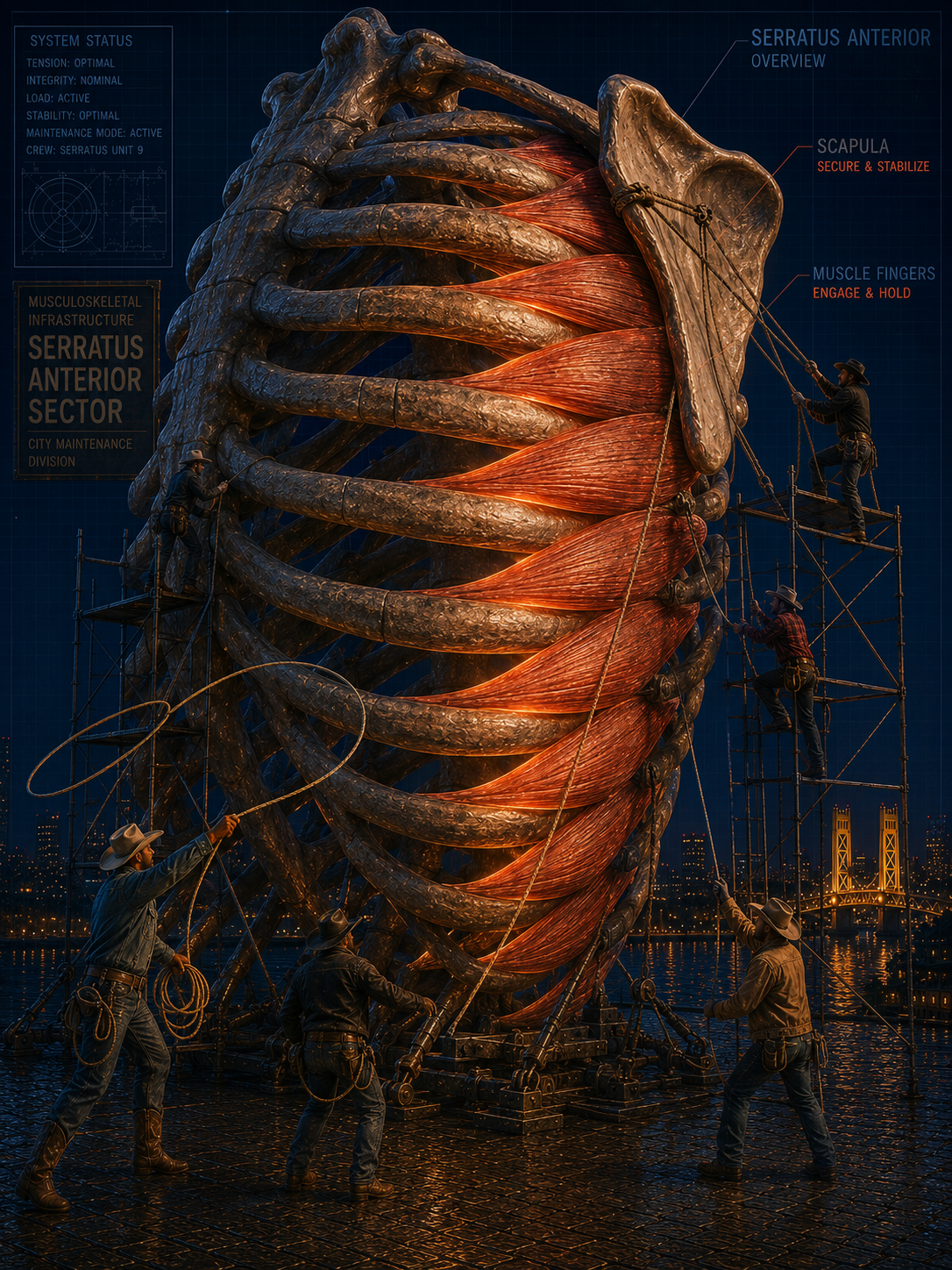
The serratus anterior is the muscle holding that platform in place. It runs like fingers along the side of the rib cage underneath the armpit, anchoring the shoulder blade flat against the ribs through every movement the arm makes. When it’s doing its job, the blade glides smoothly — rotating upward as the arm rises, staying connected through the full range. When it isn’t, the blade starts to drift. The inner edge lifts away from the rib cage. Someone notices it in a mirror, or a trainer points it out, or it shows up in a photo and the person spends ten minutes trying to figure out if that ridge along their back was always there.
The winging is real, but it’s not usually what brings people in. What brings people in is the shoulder impingement that won’t resolve, or the rotator cuff irritation that keeps coming back after it seemed to get better, or the neck that stays tight no matter what gets done to it. The serratus anterior is rarely the first suspect because it doesn’t hurt where it lives. It fails quietly, and everything downstream of it absorbs the cost.
“The shoulder is sending signals. The foundation is what’s shifting.”
The breakdown follows a pattern. Months or years of desk posture keep the shoulder blades drifted forward, leaving the serratus in a shortened, underactive state. When the arm goes overhead or presses under load, the serratus fails to anchor the blade the way it should. The upper trapezius picks up the slack, hyper-activating to keep the arm up and dragging the neck into tension in the process. Because the shoulder blade isn’t rotating smoothly, the arm bone runs out of clearance and the rotator cuff tendons get caught in the middle. The shoulder is sending signals. The foundation is what’s shifting.
Weakness in the serratus anterior doesn’t always come from posture alone. A history of nerve irritation along the long thoracic nerve can quiet the muscle down significantly, sometimes without the person connecting it to anything specific. Heavy pressing and pushing without the pulling and rotation patterns that keep the serratus engaged will gradually tip the balance in the wrong direction. By the time the winging is obvious or the shoulder is consistently problematic, the pattern has usually been running for a while.
What helps has to be specific enough to actually reach the serratus rather than letting the bigger surrounding muscles take over the way they already have been. Loaded protraction exercises — wall pushups with a deliberate plus at the top, serratus punches, bear crawl variations that demand the blade stay flat under load — work because they force the shoulder blade to wrap around the rib cage against resistance. The movement has to be intentional. Soft tissue work along the lateral rib cage, where the serratus attaches, can restore responsiveness in a muscle that’s been quiet long enough to forget what it’s supposed to be doing.
The Wranglers keep the shoulder blade roped to the rib cage because without that connection, nothing above it has a stable platform to work from. The rotator cuff, the deltoid, the whole overhead system depends on a blade that moves with the arm instead of floating away from it. When the foundation holds, the crane works. When it doesn’t, the shoulder keeps finding new ways to tell you something is wrong at the base.