
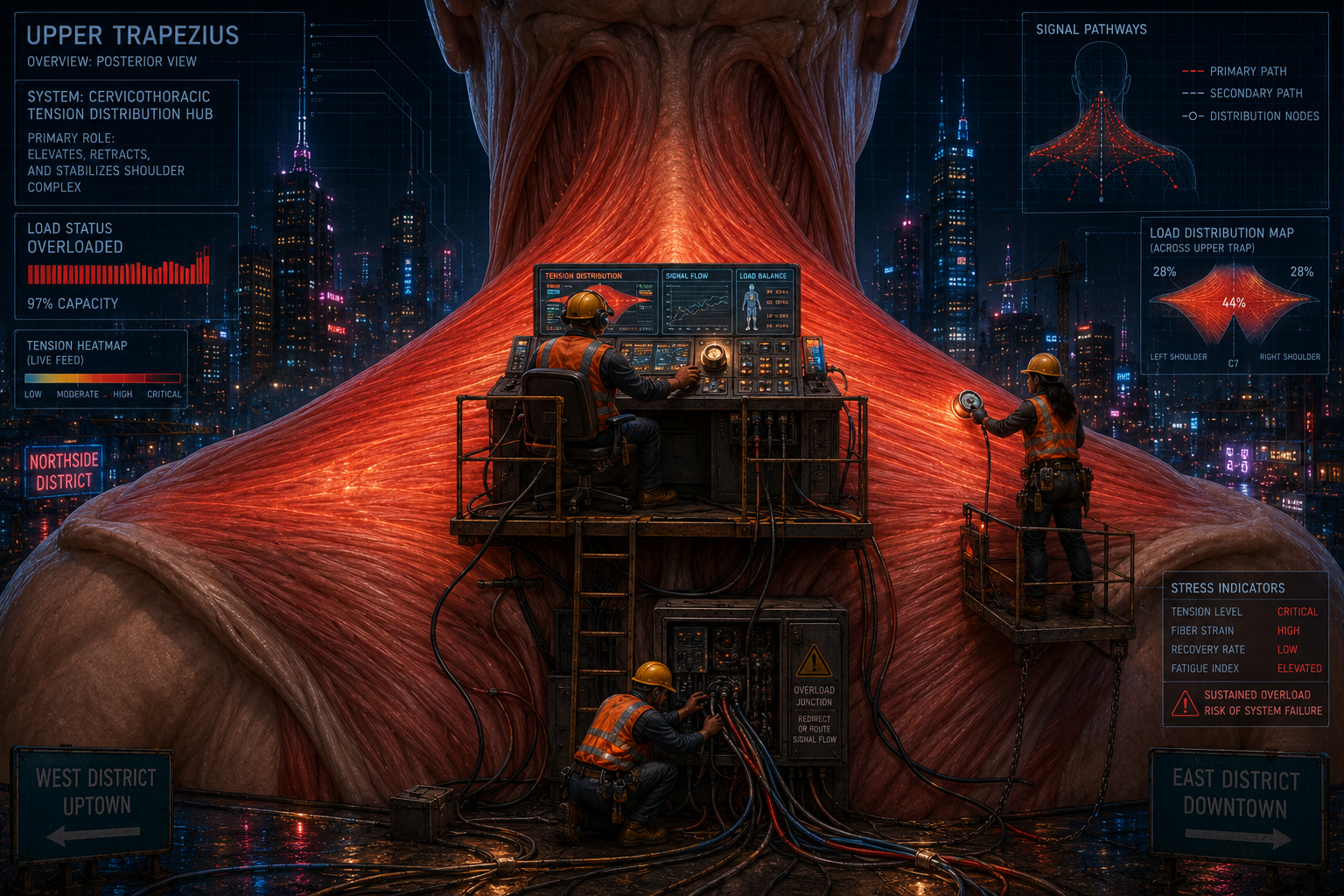
You already know this muscle. It’s the one you grab when someone offers to rub your shoulders. It’s the one that turns to concrete during a hard week at work. It’s the one that’s been tight for so long you’ve stopped noticing it and started calling it normal. The upper trapezius is the most chronically overworked muscle in the body, and the reason has almost nothing to do with physical load.
It has to do with stress.
The body has a default response to threat — real or perceived — and part of that response is raising the shoulders. It’s ancient wiring, the same system that braced our ancestors for impact. The problem is that modern stress doesn’t resolve the way physical threats do. It lingers. The shoulders go up Monday morning and come down sometime around the second drink on Friday, if they come down at all. The Dispatcher is the one doing the actual work and everyone else left before dispatch got the signal to clock out.
The upper trap runs from the base of the skull out to the tip of the shoulder, a wide triangular muscle that manages shrugging, supports the weight of the arm, and coordinates tension signals between the neck and the shoulder. It’s a communications hub. When load distribution goes wrong anywhere above the waist, the Dispatcher’s line lights up. In a body running on sustained low-grade stress, every line is lit up, all the time.
That produces a familiar knot at the top of the shoulder that never fully releases. Tension headaches that start at the base of the skull and crawl over the top toward the temple. A shoulder elevation pattern so chronic that people don’t realize their shoulders are up until someone points it out or until a massage therapist spends ten minutes trying to get them down. The pain gets blamed on the neck, or the pillow, or how long someone sat at their desk. The Dispatcher just keeps absorbing it.
Stretching helps temporarily. Massage helps temporarily. What actually changes the pattern is addressing both ends of the problem. Mechanically, the shoulders have to come down and stay down — not as a one-time correction but as a practiced habit, something you check the same way you’d check your posture. On the other end, the nervous system load has to decrease. The Dispatcher can’t relax while the system it’s connected to is still running at capacity. That’s not a muscle problem. That’s a bigger conversation.