
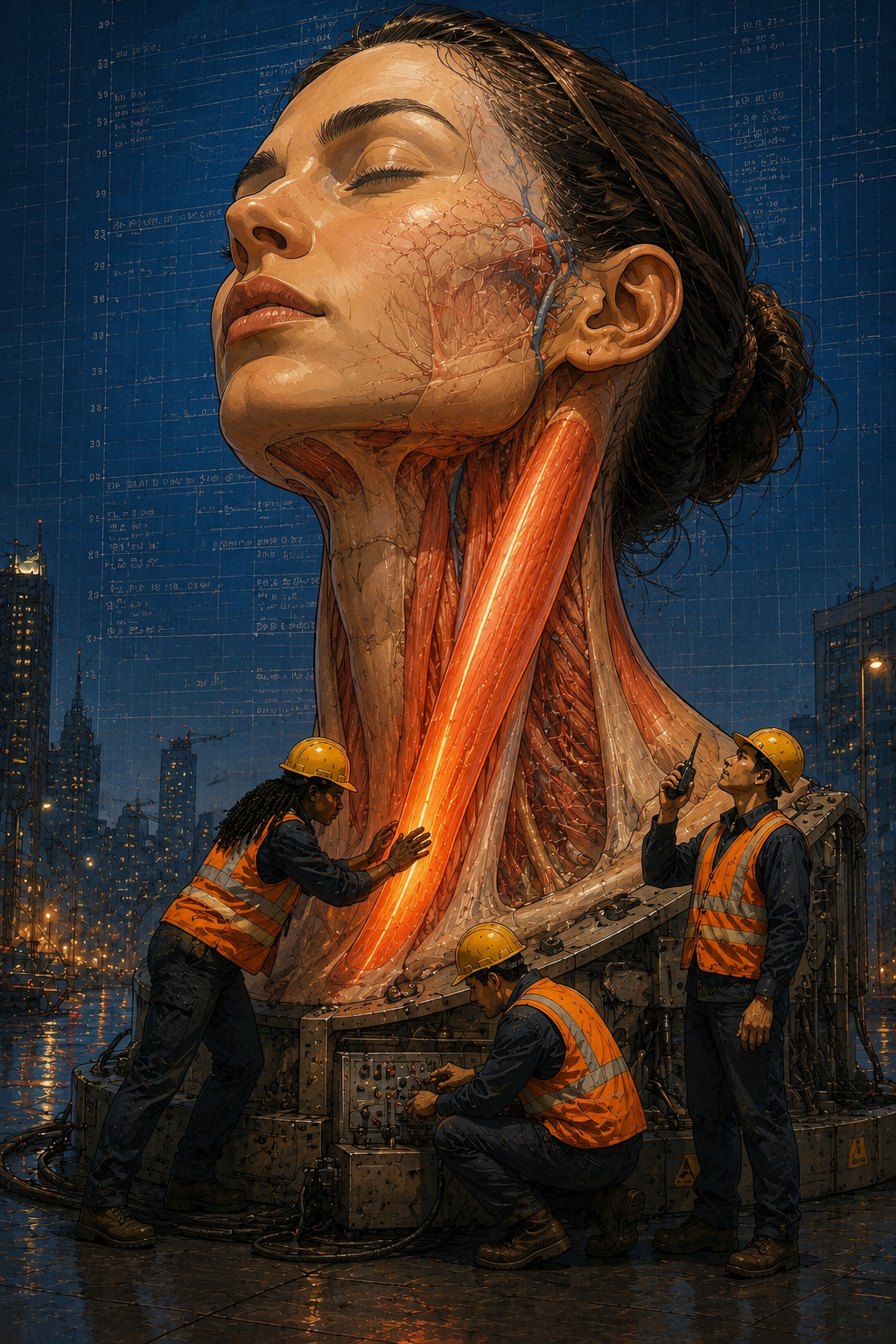
There are two of them, one on each side, running from just behind the ear down to the collarbone. When someone turns their head hard against resistance, you can see them — two distinct cords standing out from the neck like cables under load. The Sentinel is the most visible worker in the Head & Neck district. Visible, and almost never the actual problem.
The job is straightforward: rotate the head, tilt the neck, hold things steady when the load gets heavy. They are not built to hold a position all day while the rest of the crew stands around doing nothing.
When the deeper neck workers stop doing their postural job, the Sentinel gets drafted into stabilization duty. The Supervisor, the Scaffolders — that’s their shift. When they clock out, the Sentinel covers it.
A mover held in sustained contraction will eventually protest. It tightens, shortens, and starts sending pain signals into places that have nothing to do with the neck: behind the eye, across the jaw, into the temple, sometimes mimicking ear pain or sinus pressure closely enough that people spend years treating the wrong thing.
If you’ve been told you carry stress in your neck, that tight cord people always want to press on is the Sentinel. It’s working a shift it was never supposed to work.
Rubbing the cord gives temporary relief for the same reason loosening a rope gives slack: you reduced the tension locally without addressing what’s pulling on the other end. Chin tucks, gentle rotation, and restoring mobility through the mid-back — where posture actually originates — will do more for a chronically tight SCM than any amount of direct work on the muscle itself.