
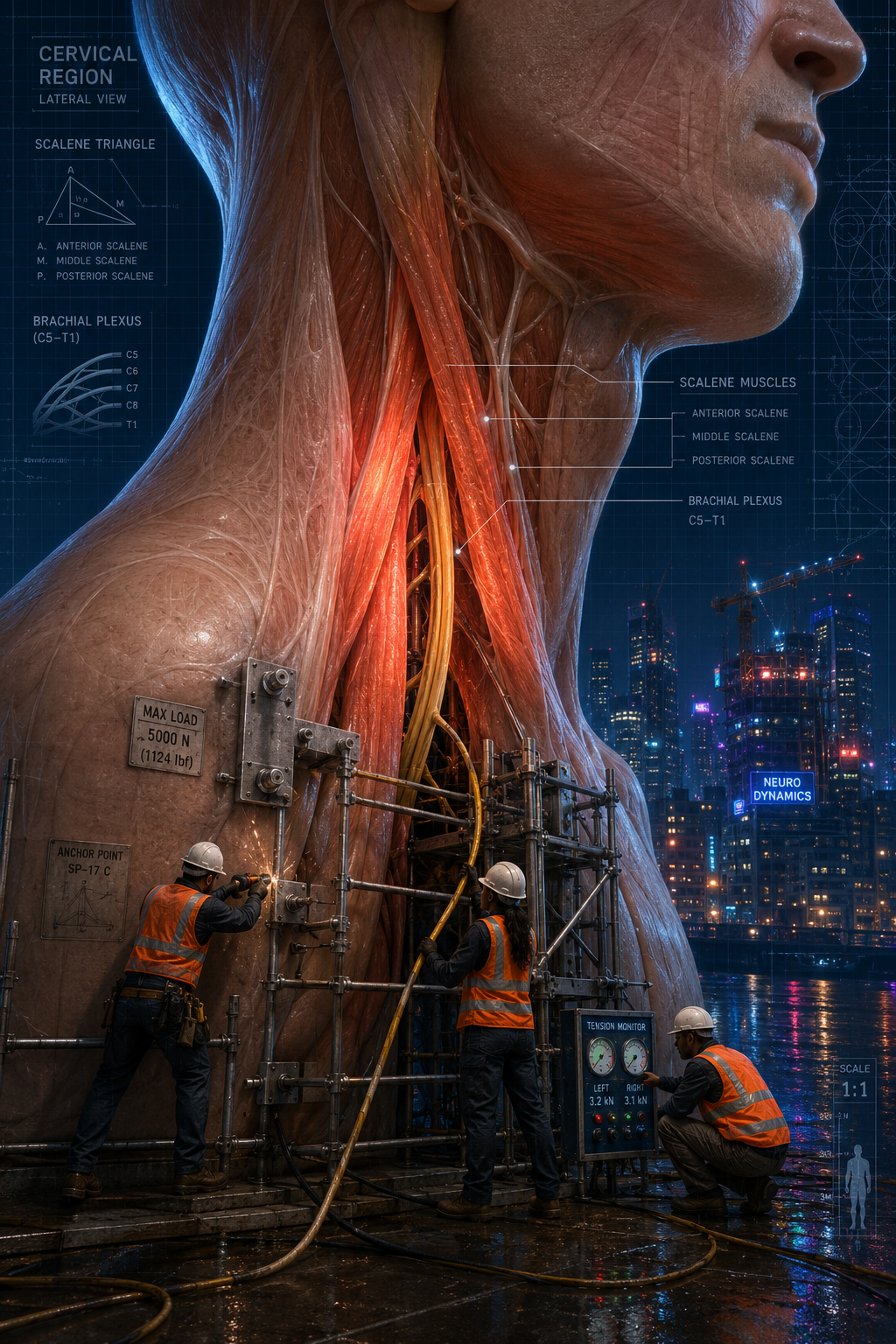
Three workers, one crew. The anterior, middle, and posterior scalenes run along the sides of the neck, and their job splits into two parts that are equally important. First: prop up the first two ribs and give the neck something stable to move against. Second, it creates the space that the brachial plexus runs through. That’s the nerve bundle that powers the entire arm, and most people never hear about that.
A human head weighs ten to twelve pounds. Every inch it drifts forward from center multiplies the effective load on the Scaffolders. Someone working at a screen all day is asking a three-person crew to do the work of six. They don’t fail dramatically. They just never fully let go. The scaffolding gets rigid, the space between the layers narrows, and what was built to protect the wiring starts compressing it instead.
The brachial plexus is a specific nerve distribution that runs directly through the scalenes. When they get pinched, that’s when your arms go numb and the pinky and ring fingers start to tingle. People get imaging done on their cervical discs. Sometimes it’s a disc. Often it’s a scalene problem wearing a disc problem’s clothes.
The other thing the Scaffolders do that nobody connects to the neck: they attach to the ribs. Which means how you breathe is directly tied to how much tension lives in the sides of your neck. Shallow chest breathing keeps the upper ribs elevated and the Scaffolders working. Deep breathing that expands the lower ribcage lets the ribs do their job and takes mechanical pressure off the crew. It’s one of the few places in the body where changing a breathing habit produces a direct and measurable change in how the neck feels.
Side-neck stretches help, but only after the breathing pattern changes. Stretching a muscle that’s still under load is like pulling on a cable that’s still anchored. The length isn’t the problem. The tension is.