Shoulder & Arm
Neighborhood
Mobility & Labor · Precision Work · Force Transfer
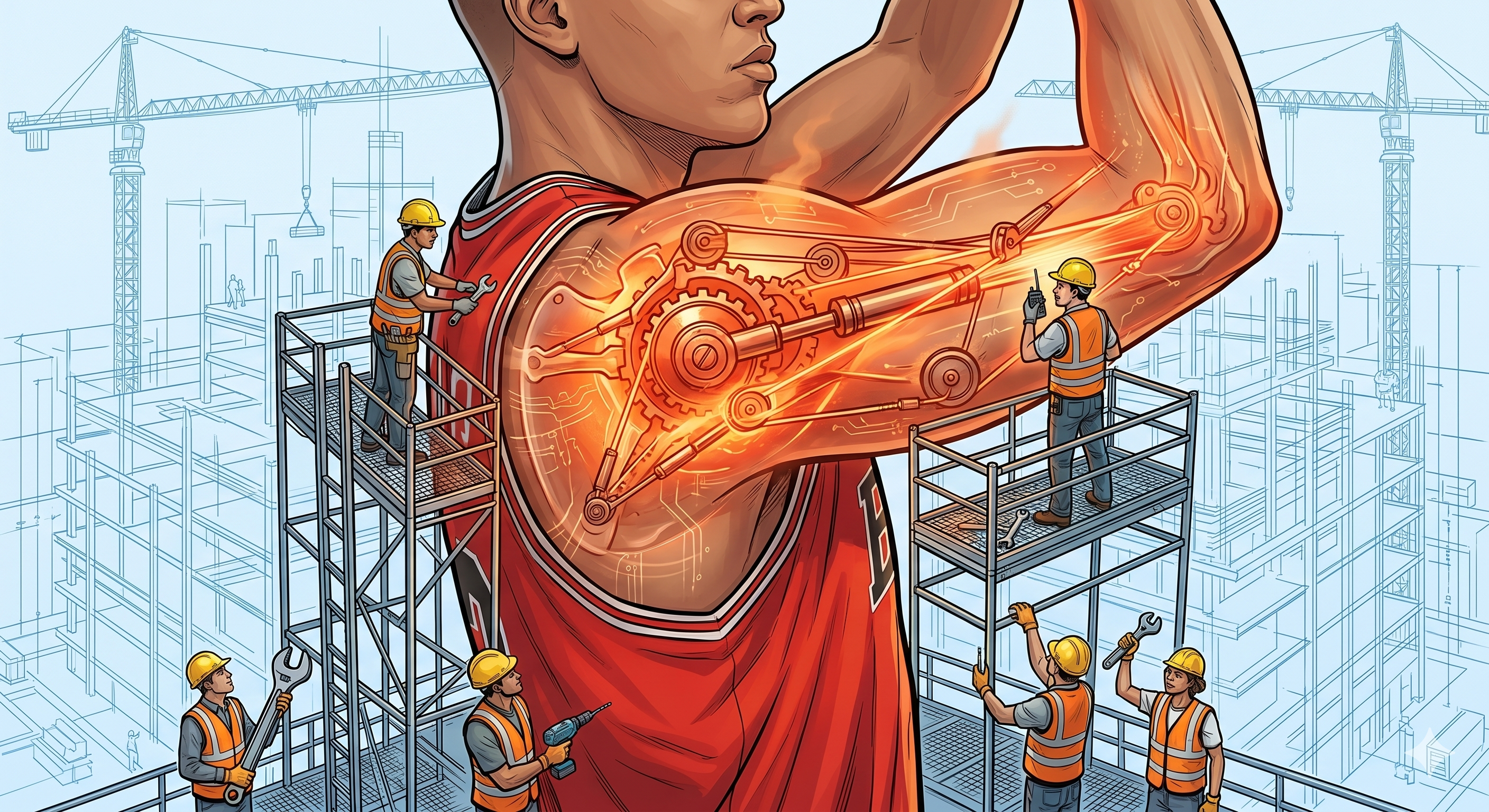
The shoulder is the most mobile joint in the human body. That sounds like an advantage. In practice, it’s a management problem.
More mobility means more potential for things to go wrong. The shoulder joint trades structural stability for range of motion, leaving the entire operation dependent on muscles doing what the bones can’t. When the team falls out of sync, it leads to the kind of stubborn shoulder impingement and chronic discomfort that feels impossible to resolve.
What This Neighborhood Does
The Shoulder & Arm district manages three things: mobility, precision, and force transfer. Mobility means getting the arm into the positions the body needs it in — overhead, across the body, behind the back. Precision means keeping the joint stable and centered through all of those movements, which requires constant small adjustments by the deeper workers. Force transfer means taking power generated by the trunk and hip and channeling it through the shoulder and arm to wherever it’s going — a throw, a push, a swing, a carry.
These three jobs are not always compatible. A shoulder optimized for maximum mobility sacrifices some stability. A shoulder locked in maximum protection sacrifices mobility. Most shoulder problems are the result of this negotiation breaking down.
The shoulder doesn’t fail because one muscle is weak. It fails because the team stops communicating.
The Workers
Four muscles. One crew. The rotator cuff doesn’t work as four separate individuals — it functions as a coordinated unit whose collective job is to keep the head of the humerus centered in the glenoid socket during every movement the arm makes. Think of them as the internal stabilization crew that the flashier outer muscles depend on. Supraspinatus initiates abduction. Infraspinatus and teres minor handle external rotation. Subscapularis manages internal rotation. Together they create the force couple that lets the deltoid and pec major do their visible work without the joint imploding. When one member of the crew stops showing up, the others compensate — until someone gets hurt.
If you’ve never heard of pectoralis minor, that’s exactly the point. It’s not the muscle people train or talk about. It sits underneath pectoralis major, attaches to the coracoid process on the front of the shoulder blade, and manages scapular tilt, depression, and stabilization. It’s doing critical administrative work while pec major gets all the credit for the bench press. When pec minor gets tight — and in anyone who sits with arms forward all day, it does — it tips the shoulder blade forward, changes the mechanics of the entire joint above it, and sets off a chain of dysfunction that the Rotator Utility Crew eventually has to deal with. Most people trying to fix impingement have never heard of this muscle.
The deltoid runs the visible operation. Three heads — anterior, lateral, and posterior — each responsible for a different direction of arm movement: forward flexion, abduction, and extension. It’s the primary mover for most arm activity, the muscle people are training when they do lateral raises, the one that shows up in the mirror. What makes the deltoid an Assistant Foreman rather than a Foreman is that it depends entirely on the Rotator Utility Crew below it to keep the joint organized. Without that stabilization, the deltoid can generate all the force it wants and still produce an injury. It knows how to work hard. It needs the crew to work smart.
Serratus anterior wraps around the outer ribcage like spread fingers, attaching to the underside of the shoulder blade and anchoring it against the rib cage during every arm movement. Its primary job is upward rotation of the scapula — without which the arm cannot reach overhead without impingement. It also keeps the shoulder blade flat against the ribcage under load, preventing the winging that signals a district losing its organizational structure. The Operations Coordinator doesn’t run the operation. It makes sure everyone else can. When the Rotator Utility Crew needs a stable platform, the Operations Coordinator provides it. When the Assistant Foreman needs the scapula in the right position to move the arm efficiently, the Operations Coordinator puts it there. Like any good operations role, it’s invisible when it’s working and immediately obvious when it isn’t. A shoulder blade that lifts off the ribcage during a push-up is a shoulder whose Operations Coordinator has gone quiet.
Common Problems
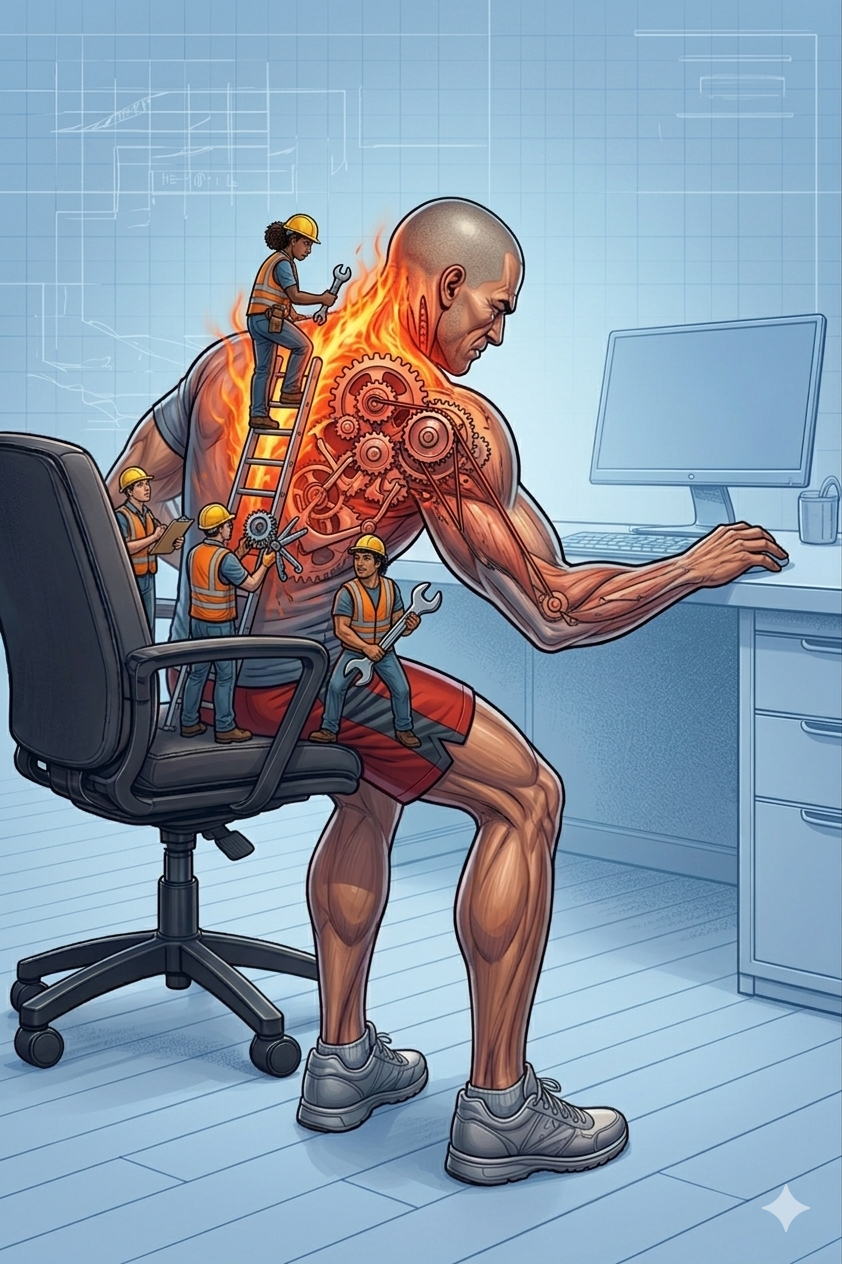
Shoulder impingement is the most common complaint in this neighborhood, and it’s almost always a management failure before it’s a structural one. The space the tendons pass through gets narrowed not because something has grown into it but because the scapula has stopped holding its position correctly, which tips the shoulder blade forward and closes the subacromial space. The City Administrator is usually involved.
Rotator cuff tears are another frequent outcome — the result of the Utility Crew working for too long without proper support from the surrounding cast. AC joint pain, anterior shoulder ache, and clicking with overhead movement all tend to trace back to the same root: the team is out of sync.
What Happens When Workers Go On Strike
When Shoulder & Arm breaks down, the compensation patterns are immediately visible if you know what to look for. The shoulder elevates — the whole complex rides up toward the ear because the scapular stabilizers have stopped holding position. External rotation disappears, so every overhead movement involves the arm compensating with internal rotation and the lower back arching to get the hand where it needs to go. The neck starts doing rotator cuff work. The Assistant Foreman starts working against a joint it can’t stabilize.
The body keeps moving. It just moves badly, and eventually something pays the price.
Self-Repair
The single most useful thing for this neighborhood is restoring scapular position. Not through stretching or foam rolling — through activating the lower trapezius and serratus anterior, which pull the shoulder blade back and down and give the Rotator Utility Crew a stable platform to work from. Everything else builds from there. External rotation strengthening, posterior capsule mobility, pec minor release — all of it matters. None of it works if the scapula is still floating in the wrong address.
Connection to Neighboring Districts
The Shoulder & Arm neighborhood can’t function without Upper Back. The shoulder blade lives on the ribcage in Upper Back territory, and what Upper Back does with it determines what Shoulder & Arm has to manage. If Upper Back fails its scapular transit responsibilities, the Rotator Utility Crew is working from an unstable base before anyone has even lifted their arm.
Head & Neck is directly affected whenever this neighborhood loses organization. The levator scapulae crosses the border, and shoulder elevation drags the neck with it. Solve Shoulder & Arm — or at least get Upper Back organized — and the neck typically responds.
Neighboring DistrictUpper Back Neighborhood → Neighboring DistrictHead & Neck Neighborhood → Return toBody City Overview →