Neighborhood 2 — Shoulder & Arm
The Rotator Utility Crew
Worker 6 — Rotator Cuff
It’s hard to ignore when something goes wrong. It announces itself with a sharp catch when you go to reach for something overhead, a dull ache that sets in after sleeping on that side, a feeling like the shoulder is grinding on itself when you move it a certain way. By that point, the crew has already been working shorthanded for a while. You just didn’t notice because they never complain out loud.
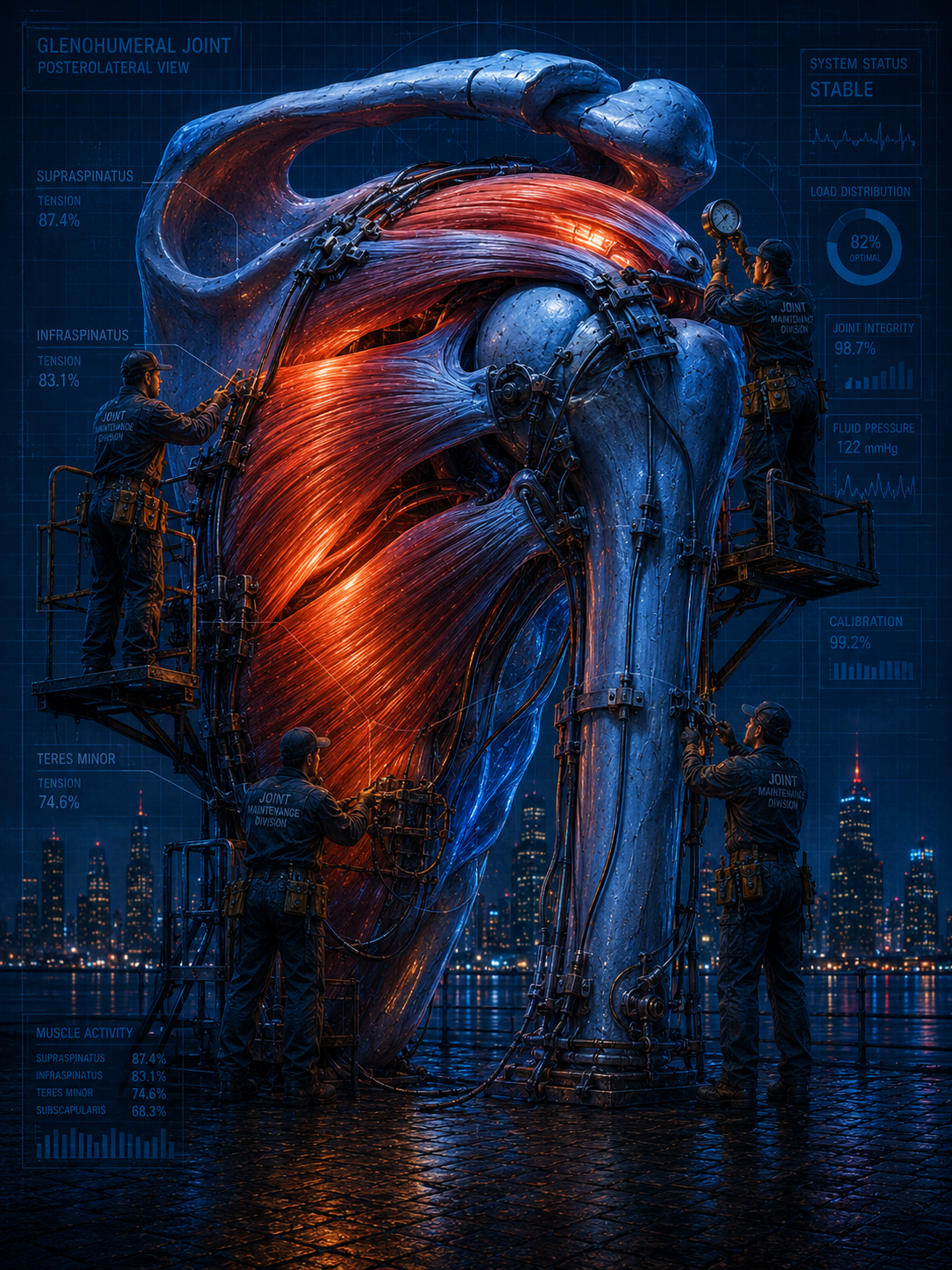
The rotator cuff isn’t one muscle, it’s four. The supraspinatus, infraspinatus, teres minor, and subscapularis work as a unit, each one covering a different angle of the humeral head, the ball of your shoulder joint. Their job isn’t to move the arm. That’s the deltoid‘s job. The rotator cuff’s job is to keep the ball seated in the socket while everything else does the moving. They’re the crew that makes sure nothing flies apart under load. Quietly, constantly, without recognition.
The supraspinatus initiates the first degrees of arm elevation. It gets the movement started before handing off to the bigger muscles. The infraspinatus and teres minor control external rotation and hold the back of the joint. The subscapularis covers the front, managing internal rotation and keeping the humeral head from sliding forward. When all four are doing their jobs, the shoulder moves like something well-maintained. When one of them starts slacking or gets overwhelmed, the others pick up the slack; and that’s usually where the trouble starts.
“They’re the crew that makes sure nothing flies apart under load. Quietly, constantly, without recognition.”
A crew that works without balance eventually breaks down. If the subscapularis gets tight and shortened, which happens more than people realize from repetitive reaching and poor posture, it starts pulling the humeral head forward in the socket. The back of the joint then has to work harder just to counteract that forward pull. Infraspinatus and teres minor end up doing double duty, staying constantly engaged when they should be resting between efforts. Over time that kind of chronic low-grade overwork creates the ache that people feel deep in the shoulder, the kind that’s hard to locate precisely and harder to stretch out.
Overhead work accelerates everything. Any activity that asks the rotator cuff to hold the joint stable while the arm is elevated puts real demand on muscles already managing the most mobile joint in the body. The shoulder can move in more directions than anywhere else, and that freedom has a price. Painting a ceiling, throwing a ball, reaching into a high cabinet repeatedly — these things aren’t inherently dangerous, but they add up fast when the crew isn’t balanced going in.
What it feels like when things go sideways varies depending on which part of the crew is struggling. Supraspinatus issues tend to create a painful arc, a specific range of elevation where the shoulder complains and then quiets down once you move past it. Infraspinatus and teres minor problems often refer pain down the back of the arm in a way that gets misread as something else entirely. Subscapularis trouble tends to show up as front-of-shoulder pain and a nagging sense of instability, like the joint isn’t quite trustworthy. None of these are dramatic. They’re the kind of thing people work around for months before they stop ignoring it.
What actually helps is restoring balance before chasing symptoms. Soft tissue work on a chronically tight subscapularis can take meaningful pressure off the back of the joint without touching the parts that hurt. Addressing external rotation weakness gives the whole crew something to work with. Sleeper stretches done consistently and correctly create space in the posterior capsule that chronic tension locks down over time. None of this is complicated, but it requires understanding that the shoulder that hurts is usually not the only part of the shoulder that needs attention.
The rotator utility crew doesn’t make headlines. They work every shift, in every movement, doing the job that makes every other job possible. When they’re healthy you never think about them. When they’re not, the whole shoulder lets you know.