
Neighborhood 6 — Leg & Foot
The Lateral Stabilizer
Worker 20 — IT Band & Associated Structures
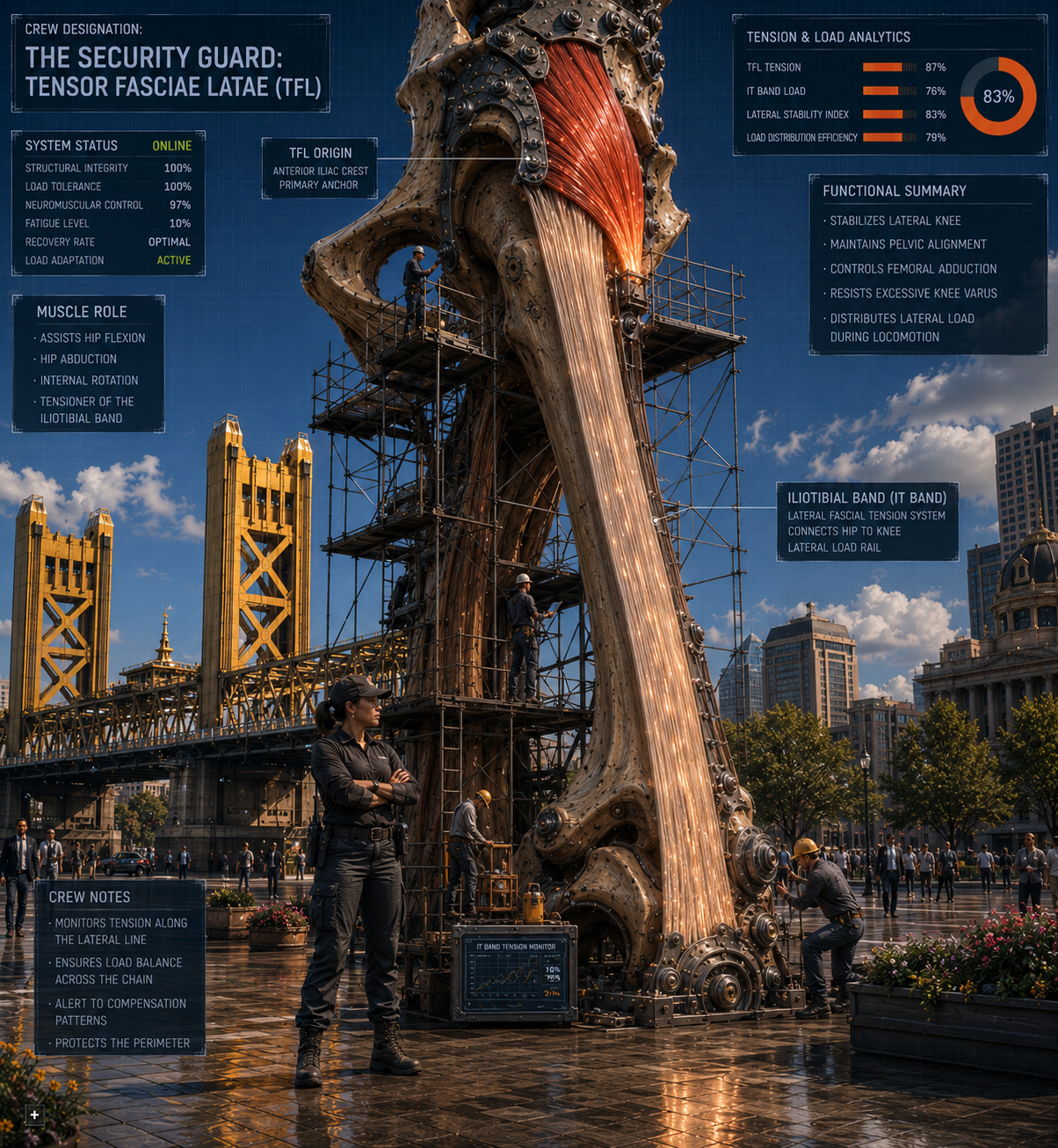
The iliotibial band is the most misunderstood structure in the body and the source of one of the most persistent myths in running and exercise culture: that it can be stretched. It can’t. The IT band is not a muscle. It’s a thick band of fibrous connective tissue — essentially a tendinous continuation of the tensor fasciae latae and gluteus maximus — that runs from the iliac crest down the outside of the thigh to just below the knee, where it attaches to a small bony bump called Gerdy’s tubercle. Connective tissue of this density doesn’t lengthen under normal therapeutic force. Foam rolling it doesn’t release it. Stretching it doesn’t elongate it. And yet it’s one of the most commonly treated structures in recreational athletics, usually with techniques that address the symptom location rather than the source.
IT band syndrome produces pain on the outside of the knee — specifically at the lateral femoral epicondyle, where the band repeatedly slides across a bony prominence during repetitive flexion and extension. The pain comes from the compression of soft tissue between the IT band and the bone, not from tightness in the band itself. Understanding this changes everything about treatment. If the band can’t be stretched and the band itself isn’t the problem, then the treatment needs to go upstream to what’s creating the tension being transmitted through it.
The sources are almost always in the hip district. The TFL, which feeds directly into the top of the IT band, is frequently overactive in people with weak gluteus medius and maximus. A hip that pronates excessively — where the femur drops and internally rotates during the stance phase of gait — creates repetitive lateral stress at the knee as the IT band is forced to resist the rotation. Weak glutes at the hip allow the knee to cave inward during landing and push-off, increasing the friction at the lateral epicondyle with every step. The lateral stabilizer is doing its structural job. The problem is what’s happening at the joints it’s attached to.
Effective treatment for IT band syndrome addresses the hip mechanics that created the problem. Gluteus medius strengthening — lateral band walks, clamshells, single-leg balance work that demands hip stability — reduces the femoral drop that overloads the band. TFL release through direct soft tissue work at the muscle belly reduces the tension it’s transmitting to the IT band. Gait analysis and correction, particularly in runners, addresses the movement patterns that created the repetitive stress in the first place. The lateral femoral epicondyle stops hurting not because anything was done to the IT band, but because the structures controlling the hip finally started doing their job.
The lateral stabilizer is doing exactly what it was built to do. It’s a structural cable that provides tensile support to the outside of the leg throughout the movement cycle. The question is never whether the IT band is working. It’s whether the hip above it and the foot below it are giving it a job it can actually manage.