
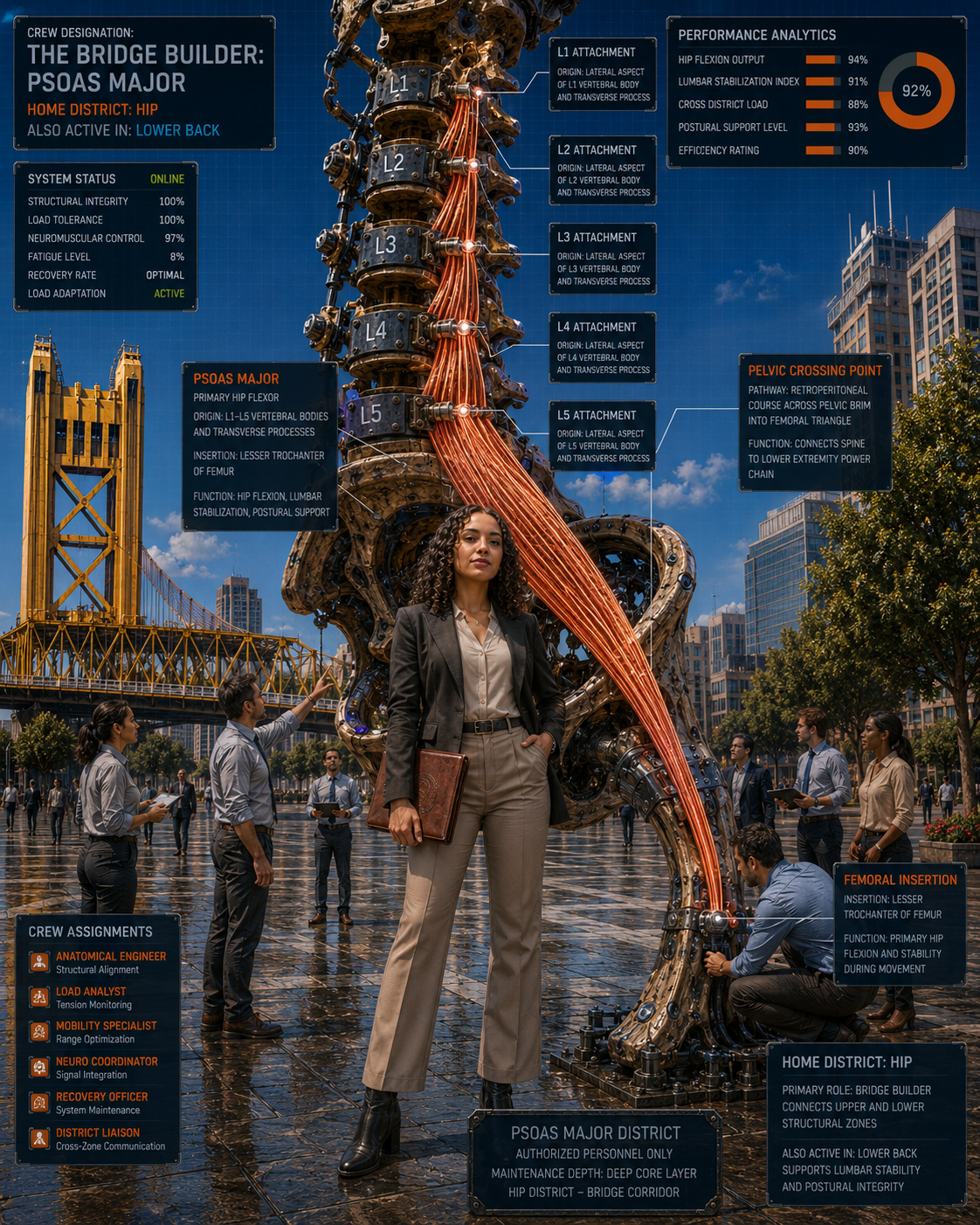
Neighborhood 5 — Hip District
The Bridge Builder
Worker 18 — Psoas Major — Hip District (Home)
Note: The Bridge Builder also appears in Neighborhood 4 — Lower Back, where it visits as a cross-district contributor. This is its home district profile.
The psoas major is the hip’s most important deep worker, and the one most people don’t know they have. It attaches to every lumbar vertebra, runs diagonally through the pelvis, and inserts on the inside of the upper femur. Its job is hip flexion — bringing the thigh toward the torso, or bringing the torso toward the thigh depending on which end is fixed. Every step you take, every time you climb stairs, every time you sit down or stand up, the psoas fires. It has been doing this every day of your life, mostly without recognition.
In the hip district, the psoas is understood differently than from the lower back’s perspective. Here it’s the primary hip flexor and a key player in lumbar-pelvic rhythm — the coordinated movement of the pelvis and spine that allows the hip to flex through its full range without the lumbar spine compensating. When the psoas can move freely through its full range, the hip opens fully, the stride lengthens, and the lower back is protected. When the psoas has shortened — through hours of sitting, through sleeping curled up, through years of running without adequate hip extension work — the hip loses range, the pelvis tips forward, and the lumbar spine gets loaded in a compression pattern that produces chronic low-grade pain that seems like a back problem but is really a hip problem.
The seated life is the primary villain in the psoas story. A muscle held in a shortened position for hours every day adapts to that shortened position. The nervous system resets its resting tone upward, the sarcomeres reorganize, and what was originally a flexible hip flexor becomes a structural limiter. The person with a chronically shortened psoas can’t walk with a full stride, can’t achieve full hip extension in a lunge or step-up, and is constantly running the lumbar spine into compression at the bottom of the movement range.
From the hip district’s perspective, the treatment approach emphasizes restoring the psoas’s full length and its coordination with the hip extensors — primarily the glute max — to recreate the balance between flexion and extension. Hip flexor stretching that specifically targets the psoas rather than the rectus femoris is more technically demanding but far more effective. Couch stretch variations, 90/90 hip flexor stretches with posterior pelvic tilt, walking lunges with a controlled forward torso lean — these reach the psoas in ways that standard kneeling hip flexor stretches don’t.
Direct soft tissue work on the psoas, accessed through the abdomen with appropriate technique, is highly effective for resetting resting tone and addressing the adhesive patterns that develop in a chronically shortened muscle. Paired with glute activation work that balances the flexion-extension equation, the psoas can return to its natural state — a powerful, flexible bridge that connects the spine to the leg and allows the body to move the way it was built to move.