
Neighborhood 5 — Hip District
The Security Guard
Worker 16 — Tensor Fasciae Latae (TFL)
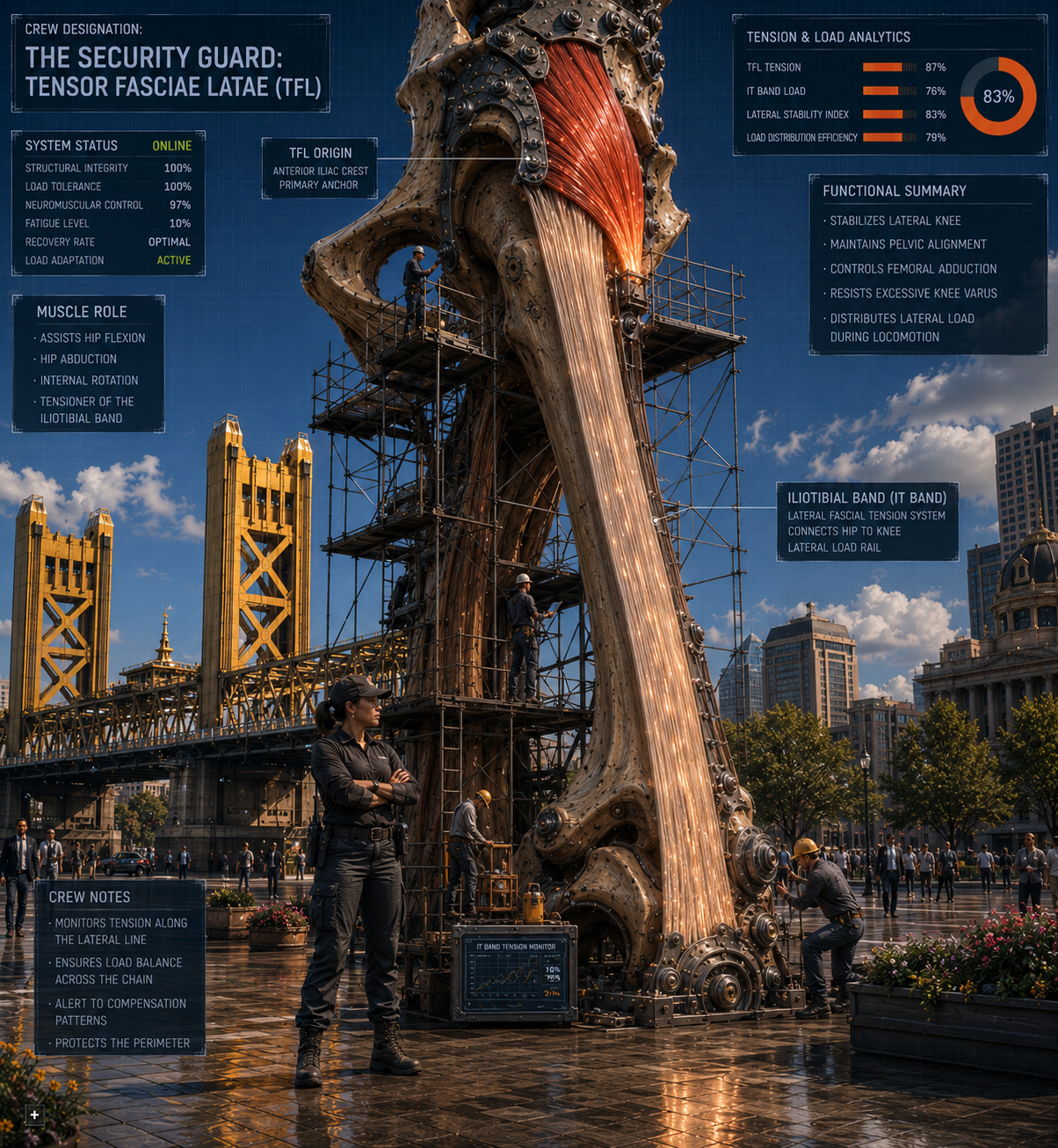
The tensor fasciae latae is a small muscle that punches well above its weight. It sits at the front of the hip, tucking in just below the iliac crest, and it does three things at once — flexes the hip, abducts the thigh, and internally rotates the leg. That combination of roles puts it in every movement pattern that involves the hip. Walking. Running. Climbing stairs. Changing direction. The TFL is involved in all of it, and when it’s tight or overactive, it has a way of making its presence known through a surprisingly wide area.
The muscle attaches to the IT band — the iliotibial band that runs down the outside of the thigh from the hip to just below the knee. This is what makes the TFL so consequential beyond its own small footprint. Tension in the TFL transmits directly into the IT band, and IT band tightness creates lateral knee pain that sends people looking for knee treatments when the actual source is sitting at the hip. IT band syndrome is almost never an IT band problem. It’s a TFL and hip mechanics problem that shows up at the knee.
The security guard analogy works because the TFL is always on duty, always watching the door, never quite off-shift. In people with weak gluteus medius and gluteus maximus — the two muscles that should be sharing lateral hip stability and hip control — the TFL compensates by staying engaged longer and working harder than it was designed to. A muscle that is never allowed to fully relax develops the kind of tone that feels like tightness but is really chronic low-level activation. No amount of foam rolling the IT band addresses this, because the IT band isn’t a muscle. It can’t release. The tension is upstream.
The TFL also participates in the anterior pelvic tilt pattern that’s endemic in modern, sedentary bodies. Tight hip flexors pull the front of the pelvis down. The TFL assists the hip flexors. The glutes, which should be counterbalancing from behind, are quiet. The result is a pelvis tilted forward, a lumbar spine compressed, and a lower back that aches for reasons that look like a back problem but are really a hip problem in disguise. The security guard is always at the same address. Find it by looking at what’s not working on the rest of the hip district crew.
Releasing TFL tension — through direct soft tissue work at the muscle belly itself rather than the IT band — provides immediate relief that surprises people who’ve been dealing with lateral hip and knee pain for months. But it’s temporary without the accompanying work. The gluteus medius needs to come back online and take its share of the lateral stability load. The hip flexors need to be lengthened so the pelvis can return to neutral. The movement patterns that kept calling the security guard to work overtime need to be retrained.
The TFL is doing its job. It’s doing everyone else’s job too. That’s the problem.