
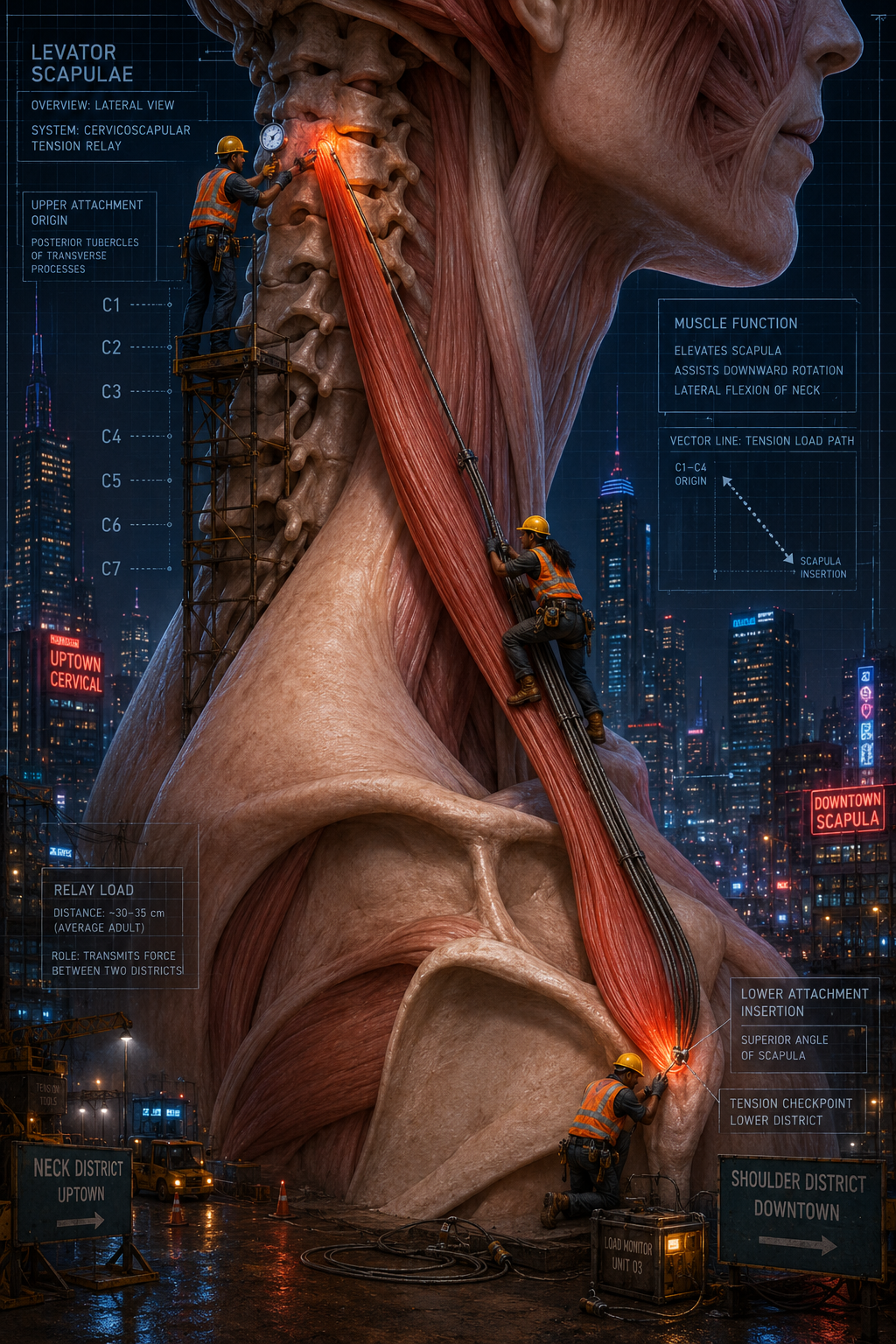
Most people who have a levator scapulae problem don’t know they have a levator scapulae problem. They know they have a neck that locks up on one side. They know they can’t turn their head without pain some mornings. And if you asked them to show you where it hurts, they’d reach back and point to that deep, specific spot just above the shoulder blade — that corner where the neck meets the upper back — and say it’s always right there.
It’s always right there because that’s where the muscle lives.
The levator scapulae runs from the upper cervical vertebrae down to the top corner of the shoulder blade. Its job is to lift the blade and help tilt the neck sideways. Simple enough. The problem is what happens when the person attached to it spends eight hours a day leaning into a screen, arms forward, head drifting toward the monitor, shoulders slowly climbing up toward their ears without them realizing it. Shoulders as earrings. It’s a good visual because it’s an accurate one. The shoulders go up, they stay up, and the levator scapulae — the muscle connecting those two points — never gets to put the weight down.
A desk worker. A driver. Anyone who lives most of their day inside a small forward box of movement. The levator is the muscle that pays for all of it.
When it finally protests, the pain is one-sided and specific. Turning the head away from the affected side is stiff and limited. Reaching across the body with the arm on that side tugs at it. The referral pattern runs up into the base of the neck and sometimes around to the shoulder joint, which is why people treat the shoulder and wonder why it doesn’t get better. The shoulder isn’t the problem. It’s just the address the pain is using.
The most effective thing you can do for a locked levator isn’t a stretch you do alone. It’s what I call the Levator Meltdown, and it needs a partner. One person places their forearm across the top of the shoulder, arm in an L-shape, and presses straight down until there’s a slight sinking feeling — the muscle being pinned in place. From there, the person being worked on brings their ear toward the opposite shoulder. That alone creates a significant stretch. Then they start to rotate the head slowly, exploring different angles until they find the position that opens it up the most for them that day. Both sides, a few minutes each. It doesn’t take long to feel the difference.
After the work is done, the cue that keeps the relief lasting is putting your shoulders in your back pocket. Not literally — it’s a visualization. Imagine trying to slide your shoulder blades down and back as if they could tuck into the back pockets of your jeans. The chest comes up, the head lifts, the neck finds the space it was designed to work in. The levator finally gets to do its actual job instead of holding everything up by itself.