Lower Back
Neighborhood
Stability & Support · Power Transfer · Load Management
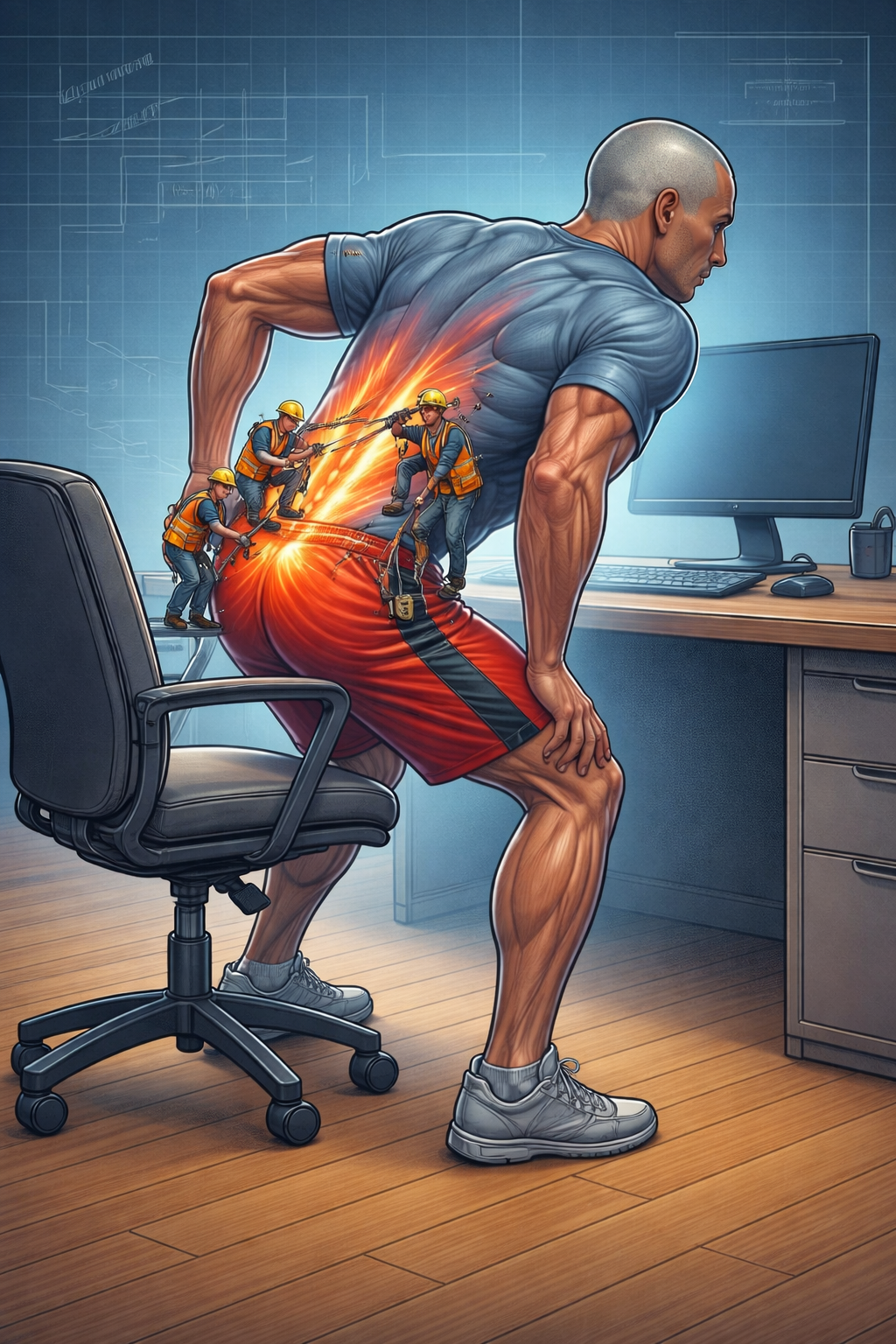
Lower back takes more blame than it deserves. It hurts, so people assume it’s weak. It’s stiff, so they stretch it. After a few years of this cycle, the diagnosis becomes ‘chronic lower back pain’ and the back gets the reputation of a problem that can’t be solved.
The reality is more specific. Lower Back is a load management district. Its job is to accept force from the ground and the hips, distribute it through the lumbar spine, and pass it upward without losing structural integrity. When the neighborhoods above and below it are working, Lower Back is quiet. When something breaks elsewhere, Lower Back becomes the city’s crisis response center — not because it’s fragile, but because it’s where the whole system converges.
What This Neighborhood Does
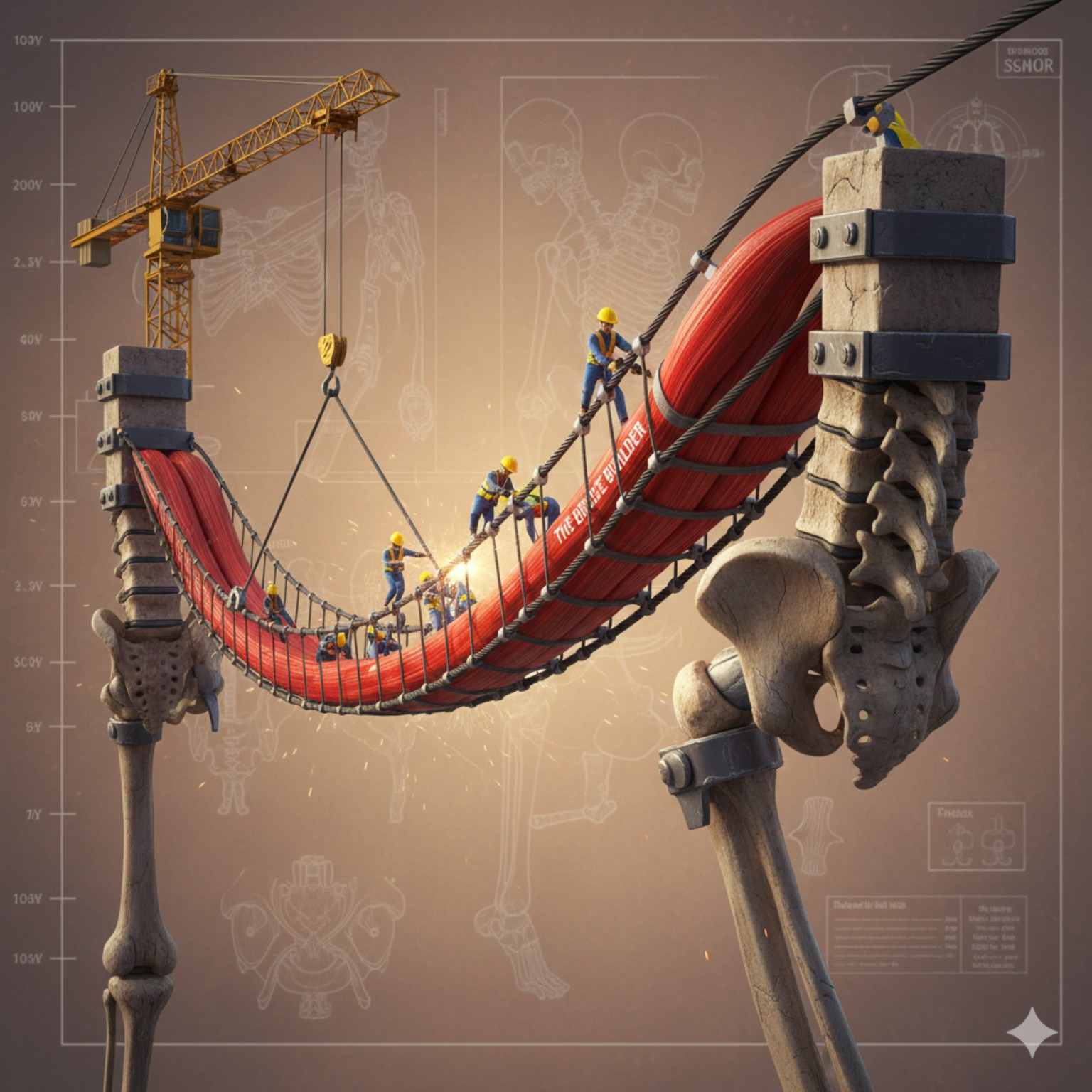
Load management means accepting compressive force from above and shear force from below and distributing both across the lumbar vertebrae without allowing any single segment to take a disproportionate share. Power transfer means taking what the Hip district generates and moving it upward without losing organization in the process. Stability means holding the lumbar spine in an appropriate position through all of this, which requires constant coordination between the deep stabilizers and the larger movers.
Most lower back pain is not a Lower Back problem. It’s a Hip problem or an Upper Back problem that has been billing the wrong address for years.
The Workers
The quadratus lumborum is the most underappreciated muscle in the lower back, and it’s doing the most critical balancing work in the district. Running from the bottom rib to the top of the pelvis on each side, the QL stabilizes the spine laterally, helps extend the lumbar spine, and most importantly, levels the pelvis from side to side. The Accountant’s job is to keep the books balanced. Every time one foot hits the ground differently than the other, every time the hip on one side doesn’t load the way it should, the QL is running the correction. Chronic QL tension isn’t a tight muscle problem. It’s a compensation problem, and the cause is almost always in the Hip district.
The erectors are not a single muscle. They’re a system — a group of muscles running the length of the spine from the sacrum to the skull, organized in layers and subdivisions that extend the back, resist forward bending, and maintain the vertical architecture the entire city depends on. Think of them less as individual workers and more as the main road itself: the primary longitudinal infrastructure the body runs on. The Engineers maintain that road. They don’t fail dramatically. They degrade under chronic load — sitting, carrying asymmetrically, moving poorly for years — until the day the road buckles under something that shouldn’t have been heavy enough to cause a problem.
The psoas commutes in from the Hip neighborhood but works as much in Lower Back as anywhere else. It attaches to every lumbar vertebra from L1 through L5 before crossing the pelvis and connecting to the inside of the femur. That path makes it one of the few structures in the body that physically connects the spine to the leg. It flexes the hip, stabilizes the lumbar vertebrae, and carries tension between districts in both directions. A chronically shortened psoas anteriorly tilts the pelvis and compresses the lumbar spine. You cannot solve Lower Back without addressing what the psoas is doing. This is not negotiable.
Common Problems
Persistent lower back pain, lateral hip hike, SI joint dysfunction, morning stiffness that loosens up after moving — these are the standard complaints. The morning stiffness pattern is particularly telling. A lower back that locks up overnight and loosens with movement is almost always a stability problem, not a structural one. The deep stabilizers have shut down and the larger muscles are trying to do their job, which means they’re holding on all night instead of resting.
Disc problems — herniations, bulges, degeneration — tend to develop at the junction between the lumbar spine and the sacrum, particularly at L4-L5 and L5-S1. These are the segments that absorb the most asymmetrical load, and they fail when the load management system around them breaks down.
What Happens When Workers Go On Strike
When Lower Back workers stop performing at full capacity, the body doesn’t stop moving. It moves with less precision. Load gets distributed unevenly across the lumbar segments. The Engineers start locking down bilaterally as a protective response — the whole lower back stiffens not because it’s injured but because the stabilization system has failed and the gross movers are trying to keep the city safe. The Accountant starts running chronic overtime trying to balance a pelvis that the Hip district isn’t holding level.
The pain shows up in Lower Back. The cause is almost always somewhere else.
Self-Repair
The most important intervention for Lower Back is hip work. Glute activation, psoas release, restoring Hip district function — this takes the compensation burden off the QL and allows the Engineers to do maintenance work instead of crisis management. From there, deep core activation and thoracic mobility give the lumbar spine the support structure it needs above and below. Stretching the lower back directly rarely resolves anything long-term. Restoring the function of the systems it’s compensating for does.
Connection to Neighboring Districts
Lower Back is the relay station between Hip and Upper Back. It cannot be treated as an independent district, because it isn’t one. The psoas crosses both its southern and northern borders. The erectors run through it on their way from the sacrum to the skull. What the Hip does with pelvic position directly shapes what the Lower Back has to absorb. What Upper Back does with thoracic rotation directly determines how much the lumbar spine has to compensate. Solve both neighbors and this neighborhood often clears on its own.
Neighboring DistrictUpper Back Neighborhood → Neighboring DistrictHip Neighborhood → Return toBody City Overview →