
One Muscle, One Problem: Why Your Lower Back Hurts When You Stand Up
Anatomy Made Simple | KnotReset
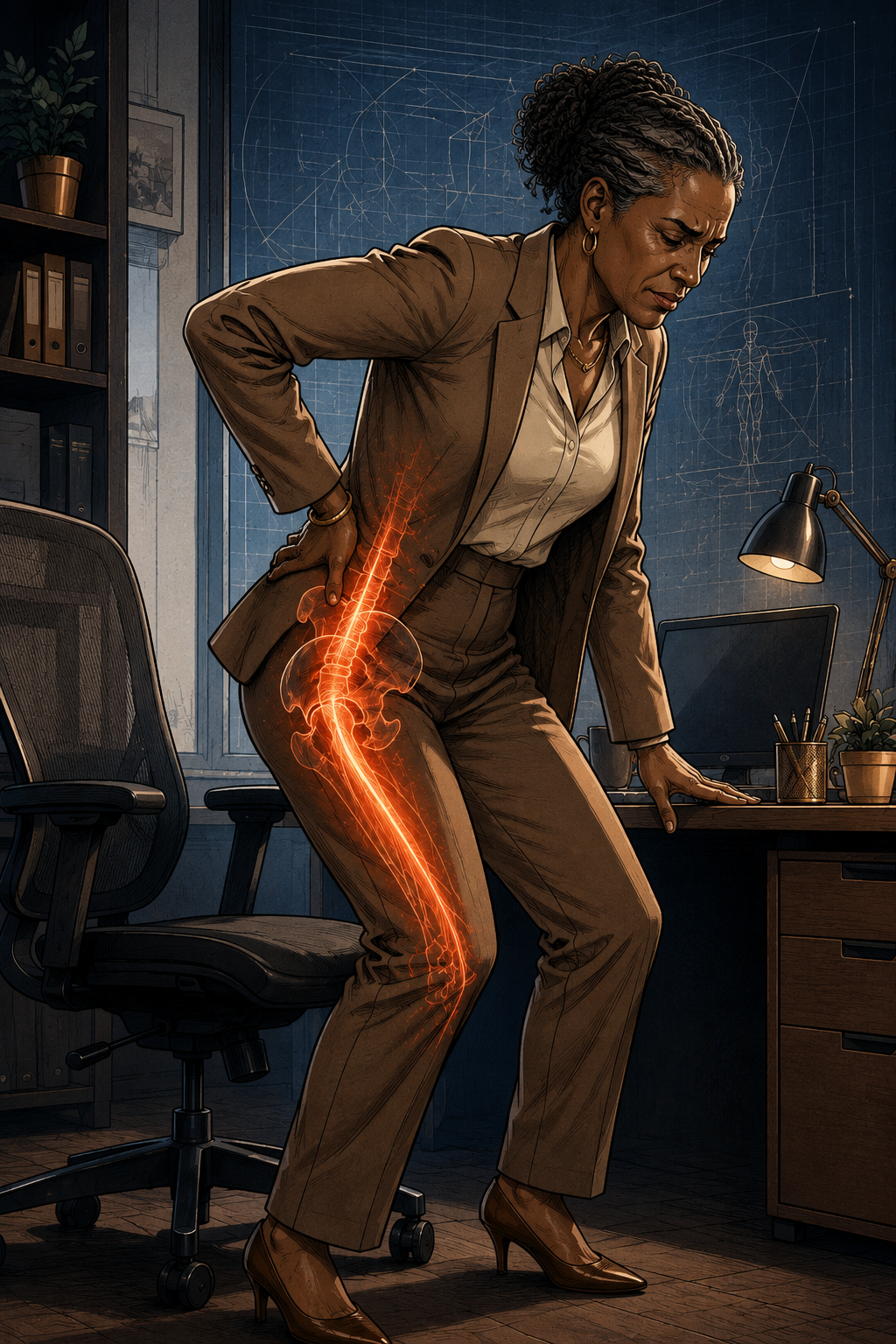
You know the feeling. You’ve been at your desk or in the car, sitting for a few hours or watching one more episode before you finally stand up. Those first few steps, with your body not cooperating right away, have you hunched forward and moving like you are sixty years older than you actually are. And you can only wait for everything to unlock.
Most people blame the back. Weak core, bad posture, too much sitting. And they’re not entirely wrong about the sitting part. But the back is usually where you feel it, not where it starts.
The muscle doing the most damage in that moment is one most people have never heard of. It’s called the psoas. Pronounced so-as. And it has a job unlike any other muscle in the body.
The psoas is the only muscle that connects your spine to your legs. It runs from the lumbar vertebrae, the low back, down through the pelvis and attaches at the top of your femur, the thighbone. When it’s working right, it helps you walk, climb stairs, and keep yourself upright without thinking about it. It’s the bridge between your upper body and your lower body, and it does its job quietly when everything is balanced.
Sitting is where the trouble starts.
When you sit, the psoas shortens. It doesn’t have a choice. The position you’re in literally compresses the distance between where it starts and where it ends. An hour of that is fine. Your body adapts. But several hours, day after day, and the psoas starts to forget what its full length feels like. It gets comfortable short. Comfortable tight.
So when you finally stand up and ask it to lengthen again, it resists. And because it’s attached directly to your spine, when it pulls, the spine goes with it. That forward hunch, that stiff shuffle for the first few steps — that’s your psoas telling you it didn’t agree to this.
The lower back pain is just the spine complaining about being yanked around.
What To Do About It
The psoas doesn’t respond well to being forced. Aggressive stretching usually just makes it grip harder. What it responds to is a combination of length and release, giving it space to let go rather than demanding it.
Half-Kneeling Hip Flexor Stretch
Get into a lunge position with one knee on the ground. The leg that’s kneeling is the side you’re targeting. Before you do anything else, squeeze the glute on that same side (the cheek of the leg that’s down). That contraction is the key. It tilts the pelvis slightly and signals the psoas to stand down. Hold that squeeze, then gently shift your weight forward until you feel a pull at the front of the hip. Not aggressive. Just present. Three slow breaths. Switch sides.
The 90/90 Hip Opener
Sit on the floor with both legs bent at ninety degrees — one leg in front of you, one to the side. The goal here isn’t flexibility. It’s rotation. This position puts the hip into a range it almost never gets during a normal day and asks the surrounding muscles, including the psoas, to reorganize around a new position. Sit tall, breathe, and let gravity do the work. Two minutes per side is enough.
Walking — Actually Walking
The psoas is designed to work through full hip extension, which is the moment in your stride when your leg is behind you and your hip is open. Short, shuffling steps that never reach full extension keep the psoas in a perpetual half-contracted state. Deliberate walking, with real strides and some intention behind it, is one of the best things you can do. Not a workout. Just a walk that actually uses the full range of motion your body was built for.
None of these are complicated. That’s the point. The psoas isn’t asking for much — just to be used the way it was designed, and given a little room to breathe when it’s been compressed too long.
Most lower back pain that shows up after sitting isn’t structural damage. It’s a muscle that’s been held in one position so long it forgot the other ones exist. Give it a reason to remember.
This same pattern of a tight muscle quietly compensating shows up throughout the body. The quadratus lumborum next door does a similar balancing act when the hips load unevenly, and the same upstream logic explains why an ankle that keeps giving out is rarely an ankle problem at all.